
How to Tell if Vintage China Is Worth Anything
Last Updated: October 25, 2026
Quick Summary
Vintage in China is worth money when demand, not age, drives the price, so a named pattern in excellent condition outsells a plain older plate. Read the backstamp first to identify the maker, pattern, and date, then check completed sold listings to set a realistic range.
- The backstamp on the underside is the fastest way to date a piece and rule out reproductions.
- Collectors pay more for complete place settings than for single orphan plates.
- A chip or hairline crack causes a large drop in value; crazing causes a moderate drop.
- Record three to five real sold prices for the same pattern and piece type before pricing.
- Pay for a formal appraisal only when the set is large, rare, or tied to an estate.
Table of Contents
- Start With the Mark: How to Identify Vintage China Marks
- Which Valuable Vintage China Patterns Buyers Actually Search For
- Vintage China Condition and Value: What Chips, Cracks, and Crazing Cost You
- A Step-by-Step Valuation Workflow: From Sold Prices to Realistic Resale
- When to Get a Vintage China Appraisal (and When Not To)
- Incomplete, Damaged, or Mismatched Sets: What to Do Next
- Explore Curated Vintage China at AtopTheTables
- Frequently Asked Questions
Start With the Mark: How to Identify Vintage China Marks
Most people asking about vintage in China make the same mistake: they search the pattern name before they read the bottom of the plate.
A maker's mark, also called a backstamp, is the printed or stamped symbol on the underside of a piece that names the manufacturer, and often the country of origin and a production date. It is the single most useful clue you have.
Where to Look and What to Record
Turn the piece over and work under good light. Marks hide in the foot ring, under the glaze, or on the rim of a lid.
Record these details before you research:
- The exact wording, including abbreviations
- Colors used in the stamp, such as blue, green, or red
- Any numbers, letters, or symbols
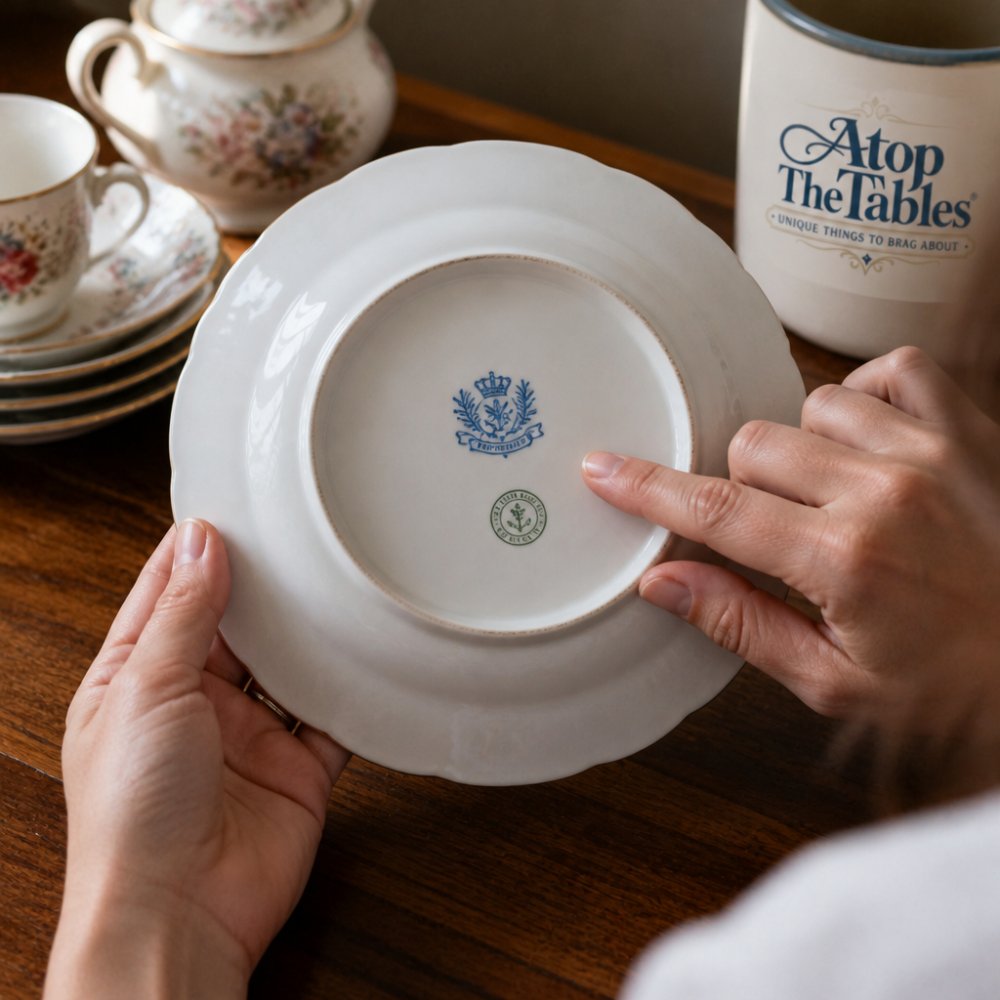
Reading Backstamps, Country of Origin, and Date Codes
Country words carry real weight. "England," "France," and "Germany" point to older production. "Occupied Japan" narrows a piece to a short postwar window.
Date codes vary by maker. Some used letter-year systems, others changed the mark itself every few decades. A common mistake is assuming one mark style covers a whole brand's history.
For a deeper walkthrough, see our guide on how to verify vintage china authenticity.
Which Valuable Vintage China Patterns Buyers Actually Search For
With vintage in China, demand, not age, drives price. A plain plate from 1890 may sit unsold for months, while a named botanical pattern moves quickly. Buyers search by pattern name, and that search behavior tells you where the money is.
Pattern Names, Motifs, and Botanical Details
Floral and botanical designs hold steady appeal. So do blue-and-white transferware patterns with named scenes.
Look for:
- A printed pattern name on the backstamp
- Recognizable floral sprays, vines, or landscape scenes
- Distinctive border designs
Collectors pay more for complete place settings than for single plates. A tureen or serving platter in a sought-after pattern often outsells a stack of dinner plates.
Why Some Patterns Command a Premium
Pattern demand clusters around a few repeatable traits. Pieces that combine several of them sell faster and for more than pieces that hit only one:
- A named, documented pattern. Patterns with a printed name and a known production run are easier to research, so buyers bid with confidence. Unnamed blanks and store-brand patterns stall.
- A complete, matching service. A pattern that lets a buyer assemble a full table, dinner plates, salad plates, cups and saucers, serving pieces, attracts buyers who want to use it, not just display it.
- Strong color and crisp transfer. Faded, rubbed, or off-register decoration drops a piece into the everyday-use tier regardless of pattern name.
How to Test Demand Before You Price
You do not need a subscription database to gauge interest. A repeatable check takes minutes:
- Search the exact pattern name in quotation marks on a major resale platform.
- Filter to completed sales and note how many sold in the last 90 days.
- Compare the number of active listings to the number of recent sales. A large gap between listings and sales signals soft demand.
- Note whether sold pieces were single plates or multi-piece lots. Lots that sell suggest buyers want usable sets, not orphans.
- Check whether serving pieces sold separately and at what premium over dinner plates.
A pattern with steady sold listings and few active ones is a seller's pattern. A pattern with hundreds of active listings and a handful of sales is a buyer's market, no matter how old the piece is.
If you are comparing pattern names, our breakdown of the most sought after china pattern covers which motifs buyers actually hunt for.
Vintage China Condition and Value: What Chips, Cracks, and Crazing Cost You
Condition decides the final number. A rare pattern in poor shape is worth less than a common pattern in excellent shape. That surprises people, and it should.
Crazing is a network of fine cracks in the glaze, and it is one of the most common condition issues on older dinnerware. It looks like a spiderweb across the surface.
Damage hits value in a predictable order:
| Condition Issue | Effect on Value | What Buyers Do |
|---|---|---|
| Chip on rim or foot | Large drop | Pass or lowball |
| Hairline crack | Large drop | Avoid for use |
| Crazing | Moderate drop | Negotiate down |
| Gold wear | Small drop | Accept if minor |
| No damage | Full value | Compete on price |
Damage, Wear, and Replacement Value
Replacement value is what it would cost to buy the same piece again, and it is usually higher than resale value.
Gold trim wears first. Light rubbing along a raised rim is normal for age.
Antique Limoges France LS&S Porcelain Cabinet Plate Gold Gilt Floral 8.5" Decor →
Watch out: a repaired chip can be nearly invisible in photos.
Caring for crazed or worn pieces takes some care. Our guide to bone china care covers cleaning and storage that protects the glaze.
A Step-by-Step Valuation Workflow: From Sold Prices to Realistic Resale
Here is the repeatable process we use. It takes about an hour per piece and saves you from guessing.
- Photograph the mark and the full piece in daylight, including any damage.
- Identify the maker, pattern, and date range from the backstamp.
- Search sold listings, not asking prices. Filter completed sales only.
- Record three to five real sold prices for the same pattern and piece type.
- Compare condition. Adjust down for chips, cracks, or heavy wear.
- Subtract selling costs, including platform fees and packing materials.
- Set a realistic range, then price at the low end if you need a fast sale.
The gap between asking prices and realized prices is where most sellers get burned. A listing at a high number means nothing if similar pieces sell for far less.
Auction results from estate sales give you the clearest picture, because the buyer competed in public. Asking prices on resale sites reflect hope, not demand.
When to Get a Vintage China Appraisal (and When Not To)
"Appraisal" gets used for three different services, and mixing them up is how people overpay for the wrong one. Before you spend anything, decide which of these you actually need.
The Three Kinds of Valuation
- An informal estimate. A dealer, auction house, or experienced collector gives you a rough range based on photos and marks. Often free or low cost, and usually enough to decide whether a piece is worth pursuing.
- An insurance appraisal. A written, signed document that states replacement value, what it would cost to buy the same piece again in the same condition. Insurers require this format, and it is typically the highest of the three numbers because it reflects retail replacement, not resale.
- An auction-house opinion. An auction specialist reviews the piece and estimates what it would bring at auction, often with a suggested reserve. This is the most realistic figure for a seller, because it reflects what a competitive public sale would actually produce after buyer's premium and seller's commission are factored in.
Match the Appraisal to the Decision
| Your situation | Valuation that fits |
|---|---|
| Curious whether a single plate is worth listing | Informal estimate |
| Insuring a large service or a rare piece | Insurance appraisal |
| Considering consigning to auction | Auction-house opinion |
| Settling an estate or dividing assets | Insurance appraisal or formal written appraisal |
| Buyer disputes your asking price | Auction-house opinion or sold-listing evidence |
When a Paid Appraisal Is Worth It
Pay for a formal appraisal only when the stakes justify it. A single common dinner plate does not need one. A large service with a rare mark, or a piece tied to an estate settlement, often does.
Get a paid appraisal when:
- The set is large and appears to be a named, sought-after pattern
- You need a documented value for insurance or an estate
- A buyer disputes your asking price
Skip it when the piece shows heavy damage, when sold listings already give you a clear range, or when the item is common and low-value.
What to Bring to an Appraisal
An appraiser works faster and charges less when you arrive prepared. Bring:
- Clear photos of the mark, the full piece, and any damage
- Measurements and piece counts
- Any history you have, such as family provenance or original packaging
Be Honest About Uncertainty
Marks get copied, and some reproductions are convincing. If a mark looks off, say so and price accordingly. A good appraiser will tell you when a piece falls outside their expertise and refer you to a specialist rather than guess.
Incomplete, Damaged, or Mismatched Sets: What to Do Next
A partial set is not a dead end. It is a different product with a different buyer.
Your options, ranked by what usually works:
- Sell as a lot to a buyer who wants pieces for daily use
- Break it up and sell single plates to collectors filling gaps
- Pair it with modern tableware for an eclectic table
Mismatched sets have real charm right now. If that is your plan, our guide on mixing vintage and modern walks through how to build the table.
One honest limitation: single orphan plates rarely sell fast. Expect to sit on them unless the pattern is in demand.
Explore Curated Vintage China at AtopTheTables
Every piece we list comes with its mark read, its date range noted, and its condition described plainly. That is the difference between buying a story and buying a surprise.
Consider a few examples from our current selection. This antique Limoges cabinet plate with gold gilt and hand-painted florals carries the LS&S decorator's mark and a Limoges France mark, with no chips, cracks, or repairs observed. A trio of Charles Ahrenfeldt Limoges plates shows minimal wear for its age. And this Belleek Bacchus Mask creamer with the Fifth Green Mark dates to roughly 1965-1980, with crisp molded detail intact.


Each listing names the maker, the origin, and the marks, so you can check the piece against the guidance above before you commit.
Frequently Asked Questions
How do I know if my old china is valuable?
Check four things in order: the maker's mark, the pattern name, the condition, and recent sold prices. A backstamp from a known manufacturer such as Limoges, Belleek, or Johnson Brothers tells you the origin and rough production period. Then compare your piece against realized prices on auction results, not asking prices. Damage such as chips, cracks, or crazing usually cuts value sharply, while a rare pattern in excellent condition with a complete set can command more. If the mark is unclear, photograph it and consult a pattern-matching service.
Do maker's marks affect the value of vintage china?
Yes, significantly. A clear backstamp identifies the manufacturer, country of origin, and often the production date, which buyers use to judge rarity and authenticity. For example, a Belleek piece bearing the Fifth Green Mark dates to roughly 1965-1980 and appeals to collectors of that period. An unmarked or heavily worn stamp makes attribution harder and typically lowers resale value, even when the porcelain itself is high quality. Record every mark you find, including decorator's marks, before you price the piece.
Is there a market for vintage china, and who buys it?
There is a steady market, though it is selective. Buyers include collectors completing a specific pattern, home decorators seeking display pieces, gift givers looking for one-of-a-kind items, and replacement services sourcing individual plates. Demand is strongest for recognizable patterns, complete place settings, and serving pieces such as tureens and platters. Common patterns in fair condition often sell slowly and at low prices, while rare patterns in excellent condition attract competitive bids. Research current resale demand before listing.
Does a complete china set have more value than individual pieces?
Often yes, but not always. A complete set in a sought-after pattern can sell for more than the sum of its parts because buyers want a ready-to-use service. However, rare serving pieces and hard-to-find replacements can individually outsell the rest of a set. If your set is incomplete or mismatched, selling piece by piece may recover more value. Assess condition across the whole set first, then compare sold prices for complete sets versus single place settings in the same pattern.
The hardest part of valuing vintage china is not the research. It is knowing which pieces are worth the effort and which marks deserve a closer look. At AtopTheTables, we read every backstamp, note the production period, and describe condition in plain terms, from the mark on the base to the wear on the gilt. Browse our curated selection and find a piece whose history you can actually trace.

