
How to Verify Vintage China Authenticity: 7 Steps
Table of Contents
- Step 1: Photograph the Piece Front and Back Before You Judge It
- Step 2: Vintage China Backstamp Identification, Limits Included
- Step 3: How to Identify Vintage China Patterns by Decoration and Form
- Step 4: Porcelain vs. China vs. Ceramic: What the Body Tells You
- Step 5: How to Spot Repaired Vintage China With Non-Destructive Checks
- Step 6: Separate Vintage Tableware From Antique Porcelain
- Step 7: Document Provenance and Know When to Call an Appraiser
- Conclusion
- Frequently Asked Questions
Last Updated: October 23, 2026
Step 1: Photograph the Piece Front and Back Before You Judge It
Learning how to verify vintage china authenticity starts with the camera, not the collector's eye. At AtopTheTables, we have handled estate and auction finds since 2003, and the first thing we do with any piece is photograph it.
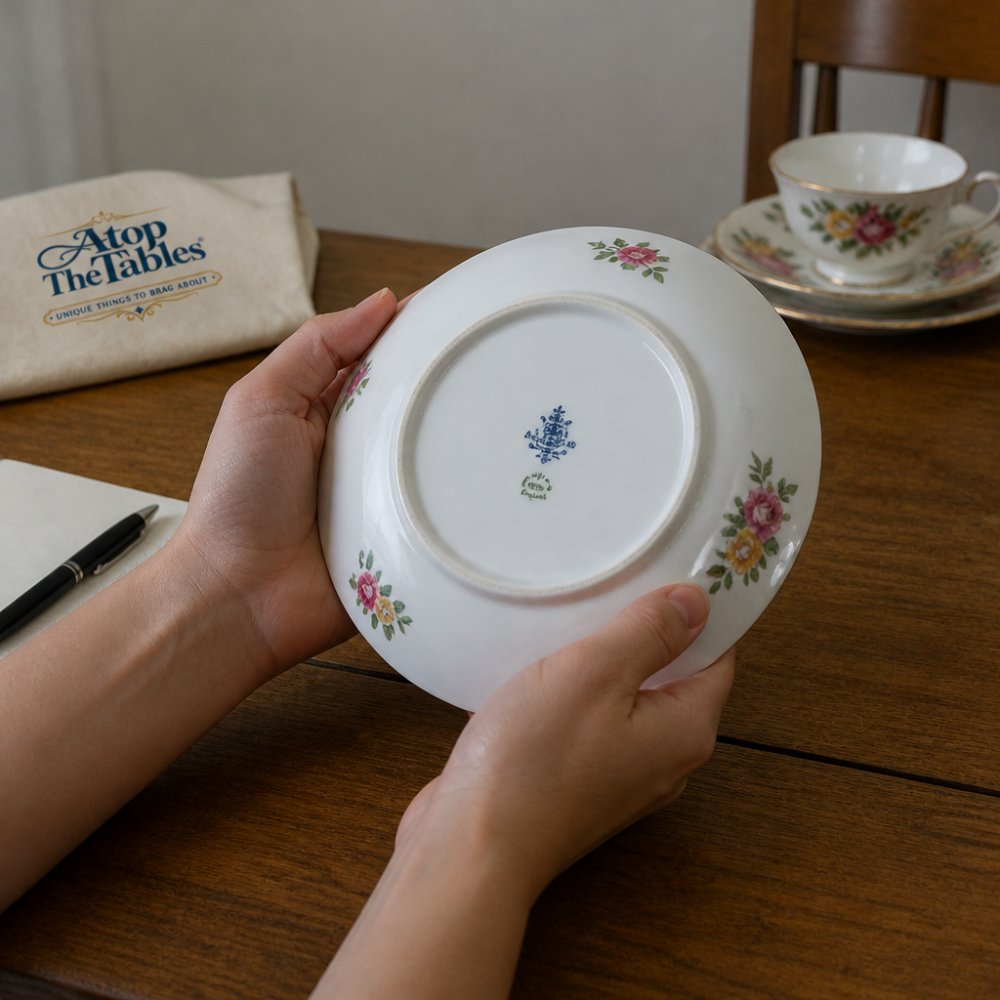
Shoot in daylight near a window. Skip the flash, which flattens glaze and hides hairlines.
Here is the shot list we use:
- Full front view, straight on
- Full back view, centered on the mark
- Close-up of the backstamp, filling the frame
- Close-up of the foot rim
- Any chips, cracks, or dull patches
- The decoration at an angle, to catch raised paint
Label each file with the piece name and date. Detail shots are where authenticity questions get answered.
Step 2: Vintage China Backstamp Identification, Limits Included
Backstamps are the fastest clue and the weakest proof. A mark tells you who made a piece and roughly when.
Read the mark in layers. Look for the maker's name, the factory mark, the country-of-origin mark, and any date mark or pattern number.
Then check the mark against the piece itself. Does the decoration style match the era the mark suggests? Is the mark crisp and evenly applied, or blurry and slightly off-center?
Why a mark match is not a match
Three failure modes account for most bad backstamp calls:
- Copied marks. Reproductions often copy a famous backstamp onto a body that does not fit it. Some counterfeiters use modern transfer prints to imitate hand-painted decoration, then apply a period-style mark to complete the illusion.
- Shared marks. Some marks were used by multiple factories, licensees, or importers, or were transferred when a company changed hands. A mark that looks definitive may belong to a whole family of wares made in different decades.
- Altered marks. A mark can be ground off and re-applied, overstamped, or added later to an unmarked blank. Look for scratches, haze, or a glaze ring around the mark that suggests removal or re-firing.
How to corroborate a mark
Treat any single mark reading as a hypothesis and test it against at least two independent clues:
- Body and form. Does the shape, weight, and foot style fit the production window the mark implies?
- Decoration technique. Hand-painted versus printed, underglaze versus overglaze, hand-applied versus printed gold.
- Pattern number and shape number. Do they appear in a documented pattern list or reference book for that maker?
- Wear pattern. Genuine age wear collects on high points and rims; a uniformly fresh surface under an old mark is suspicious.
- Provenance. Receipts, auction slips, and estate records can confirm a mark reading that physical inspection alone cannot.
For a deeper walkthrough of reading and interpreting porcelain marks, see our guide to identifying valuable vintage porcelain marks.
Step 3: How to Identify Vintage China Patterns by Decoration and Form
Pattern identification works best when you study decoration and shape together. The pattern name, the pattern number, and the body form should all agree.
Start with the decoration. Note the colors, the motif, and the technique:
- Cobalt blue underglaze versus painted-over blue
- Hand-painted brushstrokes versus a printed dot pattern
- Gold applied by hand versus a flat printed gold band
- Floral, scenic, or geometric motifs
Then look at form. Teacup handles, plate rims, and pitcher shapes changed with the decades.
Search image databases using your photos, front and back. Visual identification tools are useful for narrowing a pattern name. Treat the result as a lead, not a verdict.
Step 4: Porcelain vs. China vs. Ceramic: What the Body Tells You
The words get used loosely, so here are working definitions. Porcelain is a high-fired ware made from kaolin clay, fired hot enough to vitrify, which makes it hard, dense, and slightly translucent. China is a common label for porcelain dinnerware, especially bone china, which adds bone ash for whiteness and strength. Ceramic is the broad family that includes earthenware, stoneware, and porcelain.
The body tells you which one you have:
- Hold it to a strong light. Light glowing through a thin section suggests porcelain.
- Tap the rim gently. Porcelain rings clear and high; earthenware thuds.
- Check the foot. Unglazed, gritty feet usually mean earthenware.
- Look for crazing. Fine glaze cracks are common on older earthenware and do not always signal damage.
This matters for authenticity because fakes often use the wrong body. A "porcelain" piece that thuds when tapped is a red flag.
Step 5: How to Spot Repaired Vintage China With Non-Destructive Checks
Repairs hide in plain sight, and most of them show up under careful, gentle inspection. Never scrub, soak, or test with chemicals to find them.
Run these checks in order:
Antique Limoges France LS&S Porcelain Cabinet Plate Gold Gilt Floral 8.5" Decor →
- Fingertip test. Run a clean finger slowly around the rim and foot. Repairs and chips feel rough where the eye sees smooth.
- Raking light. Tilt the piece under a lamp. Filled chips and glue lines cast shadows that vanish in flat light.
- UV light. Many modern adhesives and fillers glow under ultraviolet light. Original glaze usually does not.
- Tapping. A dull thud near a repair can mean a filled crack.
- Color match. Repainted areas often sit a shade off from the original decoration.
For safe cleaning methods that will not harm glaze or gilt, our guide on the best ways to clean vintage china covers what to use and what to avoid.
Step 6: Separate Vintage Tableware From Antique Porcelain
Vintage and antique are not the same thing, and mixing them up skews both value and authenticity claims. Antique generally means at least 100 years old.
That gap matters. A 1970s stoneware platter is vintage, not antique.
Period features help you place a piece:
- Shapes and motifs tied to a known design era
- Marks that match a documented production window
- Regional style, such as Bavarian floral decoration or English blue-and-white
If the vintage-versus-antique line still feels fuzzy, our explainer on the antique versus vintage definition breaks it down with clear examples.
The two age labels carry different meanings, and the article sets the boundary plainly.
| Term | Age threshold | Example given |
|---|---|---|
| Antique | At least 100 years old | Not specified in article |
| Vintage | Often 20 to 99 years | 1970s stoneware platter |
| Vintage porcelain | Roughly 1965 to 1980 | Belleek creamer, Fifth Green Mark |
Step 7: Document Provenance and Know When to Call an Appraiser
Provenance is the ownership history of a piece, and it is the strongest support a backstamp can get. Paperwork, auction records, estate labels, and family notes all count, but not all paperwork is equal. A receipt is stronger than a handwritten note, an auction catalog entry with a lot number is stronger than a verbal family story, and a documented chain of ownership is stronger than a single document with no link to the piece.
Build a file that would survive scrutiny
Keep a simple file for each piece:
- Your photos, front and back, plus detail shots of the mark and foot rim
- The backstamp reading, pattern name, and pattern number
- Where and when you bought it, and from whom
- Any receipts, auction slips, estate inventory labels, or import and export paperwork
- Notes on condition, including any repairs you found under UV light
How to assess provenance documents
Ask three questions of every document:
- Does it describe this piece? A receipt for "one dinner plate" is weak; a receipt that names the pattern, the maker, and the quantity is strong.
- Is the chain unbroken? A single document from 1950 tells you little if the piece passed through three owners since. Look for a sequence, estate inventory, then auction catalog, then dealer receipt, that links owner to owner.
- Is the source independent? A dealer's own description is a claim; an auction house catalog entry, an estate attorney's inventory, or a customs record is evidence. Favor documents created by someone with no stake in the sale.
Import and export documentation is often overlooked and unusually useful. A piece that was shipped internationally in a given decade will usually have a customs or shipping record that names the consignor, the consignee, and the description, a documentary anchor that is hard to fake convincingly.
Identification, insurance appraisal, and resale valuation are not the same thing
This is where most owners get confused. An identification tells you what the piece is, maker, pattern, approximate date. An insurance appraisal assigns a replacement value for coverage purposes and is usually written to a defined standard with a stated effective date.
When the stakes are high, bring in an independent appraiser. Look for one with credentials in decorative arts and a background in the specific ware you own, porcelain, earthenware, and bone china are not interchangeable specialties.
When to call a specialist
- The piece is a candidate for insurance coverage or a significant resale
- The mark reading and the physical evidence disagree
- You suspect a repair, restoration, or altered mark
- Provenance documents are incomplete or contradictory
- The piece is part of an estate or a potential donation
Once a piece checks out, protect it. Our guide on bone china care covers cleaning, storage, and long-term protection.
Conclusion
The hardest part of buying old china is the gap between a pretty photo and a piece you can trust. Work the seven steps in order, keep your photos and notes, and let an appraiser settle the close calls.
At AtopTheTables, every piece is hand-picked from estates and auctions, and we describe condition, marks, and origin in plain terms so you know what you are getting. Browse our china and pottery collection to find verified pieces with a story behind them.
Frequently Asked Questions
Can a maker's mark prove that vintage china is authentic?
No. A backstamp identifies who made or decorated a piece and roughly when, but reproductions often copy the mark exactly. Treat the stamp as one clue among several: compare it against a reference source, then check the body, glaze, decoration, and wear. On a genuine antique Limoges cabinet plate, for example, the decorator's mark and country mark should be consistent with the hand-painted floral work and the rubbing on the raised gilt rim. If the mark looks crisp and new while the piece shows no age, that mismatch is the warning sign.
What is the difference between ceramic, porcelain, and china?
Ceramic is the broad category for fired clay. Porcelain is a specific type fired at higher temperatures from kaolin and other fine clays, which makes it dense, hard, and translucent at the edges. China is a common term for porcelain tableware, especially the thin, decorated wares made for dining. In practice, most vintage plates and teapots sold as china are porcelain or fine earthenware. Knowing which one you hold tells you how it should sound when tapped, how heavy it feels for its size, and how much wear is normal.
How do I check vintage china for repairs or replacements?
Look at the piece in raking light and run a fingertip slowly across rims, handles, and spouts. Repairs show as a change in texture, a faint line under the glaze, or a patch that reflects light differently. A blacklight helps: many modern glues and fillers fluoresce where the original glaze does not. Also check that pattern alignment continues across a repaired area and that the gold trim looks even. Ask whether the set's pieces carry matching marks and decoration, since replacements are often added later to complete a service.
How do I identify a vintage china pattern?
Start with the backstamp and any pattern name or number printed on the underside, then photograph the front decoration in good light and compare it with reference books and image search results. Note the motif, border style, and color palette: a cobalt-blue floral spray with a geometric rim border is a different pattern from a plain gilt band. Record the maker, pattern name, and piece type together. If the mark is worn, the decoration and shape often identify the pattern faster than the stamp alone.

