
Harmony Kingdom Box Figurines: A 2026 Collector's Guide
Table of Contents
- What Is Harmony Kingdom? A Beginner's Introduction
- The Harmony Kingdom Archives: A 2026 Auction Story
- How Harmony Kingdom Box Figurines Are Made
- Peter Calvesbert: The Master Carver Behind the Designs
- Collectible Miniature Figurines: Series, Editions, and Rarity
- How to Identify a Genuine Harmony Kingdom Piece
- Harmony Kingdom Value: What Affects Secondary Market Prices
- Caring For and Displaying Your Figurine Collection
- Conclusion
- Frequently Asked Questions
Last Updated: September 23, 2026
What Is Harmony Kingdom? A Beginner's Introduction
Harmony Kingdom is a line of collectible box figurines, hand-carved in England and prized for their intricate detail, hidden interior carvings, and wry sense of humor. Each piece looks like a small sculpture of animals or characters, but the top lifts off to reveal a secret scene inside. This guide from AtopTheTables covers what these pieces are, how they were made, and what a buyer should know in 2026.
Most people encounter their first Harmony Kingdom piece without realizing what they're holding. The figurine feels heavier than expected, the surface carries a subtle stone-like texture, and somewhere on the base sits a tiny carved mouse. That mouse is one of the line's signatures, and it's usually the first clue that you're looking at something more than a decorative object.
The line grew a devoted following over roughly two decades of production, and the collector community still trades pieces actively on the secondary market. What sets Harmony Kingdom apart from ordinary figurines is the combination of hand craftsmanship, deliberately small production runs, and the fact that the artist hid jokes and personal references inside almost every design.
The Harmony Kingdom Archives: A 2026 Auction Story
In August 2026, a remarkable thing happened for collectors: the former Harmony Kingdom Archives inventory was dispersed at auction in Columbus, OH. These were the pieces the company itself had kept in storage, not pieces that had passed through retail. AtopTheTables acquired hundreds of them, and we're now cataloging, photographing, and rolling out the inventory piece by piece.
Why does provenance from the Archives matter? A figurine that never left company storage carries a different story than one that sat on a shelf for twenty years. The Archives pieces were preserved as reference examples, which means many survived in unusually clean condition and still carry their original paperwork.
That paperwork is the real prize. When an identification card or mini brochure accompanied a piece in the Archive, it stays with the piece. Some Archive examples had no paperwork at all, and no replacements exist, so what you receive is exactly what was preserved.
How Harmony Kingdom Box Figurines Are Made
Production started with a carved master, then moved through a mold and a casting process before any painting began. The material itself is the reason these pieces feel different from ordinary resin figurines, and the marks left on the base are the reason collectors can trace a piece back to a specific design and production run.
Crushed Marble, Resin, and the Casting Process
The body of a Harmony Kingdom piece is a composite of crushed marble and resin, often called marble dust or marble resin. That mixture gives the finished figurine the cool weight and fine surface texture of carved stone while allowing the deep undercuts and thin details that a solid carving could not hold.
The artist carved the original in fine detail, and a mold was taken from that master. Every production piece was cast from the mold, then finished by hand. Because the mold captures the master exactly, the intricate detail survives into production: fur texture, individual feathers, the grain of a leaf.
A useful way to picture the sequence:
- The artist carves the master by hand.
- A mold is taken from that master.
- Each production piece is cast from the mold in marble dust and resin.
- The cast piece is cleaned, assembled, and hand-painted.
- The base is marked with the backstamp, hallmark, and edition notation before the piece is boxed.
Step five is the one beginners overlook, and it is the step that makes the piece identifiable decades later.
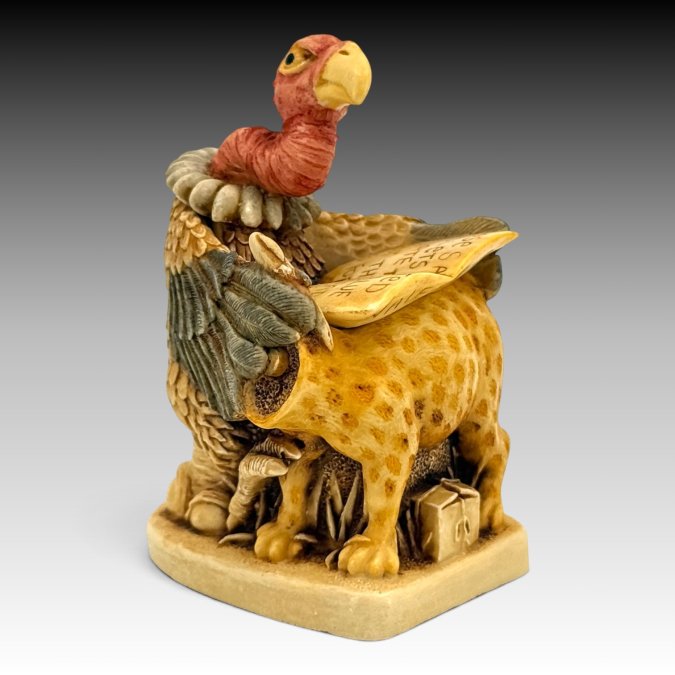
Have A Heart was created by Peter Calvesbert and became the first of Harmony Kingdom's infamous “Banned Boxes.”
Hand-Painted Detail and Hidden Secrets
Painting was done by hand, which is why no two pieces are perfectly identical. Eyes, whiskers, and small color accents were applied individually, and slight variation between examples is normal rather than a defect.
The hidden secrets are the part collectors talk about most. Lift the lid and you find an interior scene that continues the joke on the outside. In Troubled Waters, a fish farming design from Peter Calvesbert's Treasure Jests, opening the box reveals a hidden fish inside the removable lid. In Boom Box, built around the boxfish, the interior is arranged like a miniature aquarium complete with a goldfish and an unlucky mouse.

Harmony Kingdom Troubled Waters Fish Farm TJFI10 LE 300 Peter Calvesbert Archive
Reading the Base: Hallmarks, Backstamps, and Edition Notations
This is the part of the process that matters most after the piece leaves the workshop. Every genuine piece carries a backstamp or hallmark on the base, and that mark is the piece's birth certificate. It typically combines several pieces of information:
- The line or maker mark. A stylized mark that identifies the piece as part of the Harmony Kingdom line.
- The design name or code. A short alphanumeric code, such as TJFI10 for Troubled Waters or TJHA for Choked Up, that ties the piece to a specific design record.
- The edition notation. Wording that states whether the piece is a Fixed Edition and, when applicable, the size of that run.
- The carver's mark or signature detail. On many designs, the artist's initials or a small personal mark appears near the edition notation.
- The production year or release reference. Some pieces carry a year or a date reference that helps place them in the production timeline.
Because the mold captures the master exactly, the hallmark is cast into the base rather than stamped on afterward. That means the mark should be crisp, legible, and consistent with the design it appears on. A hallmark that is blurry, misaligned, or paired with the wrong design code is the first thing to question.
A practical identification workflow for a piece you don't recognize:
- Look around the base and photograph the entire base in good light.
- Read the design code and write it down exactly as it appears.
- Note the edition notation and any year or date reference.
- Compare the code against the design name you believe the piece represents.
- Check whether the piece is documented as carrying a hidden mouse or interior secret, and confirm it is present.
Most people find that the design code is the fastest route to an identification. Once you have the code, the design name, carver, and edition structure usually follow from it. The hallmark does not tell you what a piece is worth on its own, but it tells you what the piece is, and that is the question every other question depends on.
Peter Calvesbert: The Master Carver Behind the Designs
Peter Calvesbert is the carver most closely associated with Harmony Kingdom, and his signature style defines what collectors recognize instantly. His designs lean on wordplay, animal behavior, and small personal inscriptions that reward close looking.
Boom Box carries the inscription "22 APR CUCKOO" on its rocks. Spring in England is traditionally heralded by the cuckoo returning from Africa, and Calvesbert recorded spotting one on April 22. That kind of private note is typical: a date, a name, an in-joke, carved where only an owner would find it.

Harmony Kingdom Boom Box Fish TJFI4 Fixed Edition Peter Calvesbert Archive
His range runs from the crowded and comic to the deliberately spare. Samsara, a 2004 study of a single toad, contains neither the signature hidden mouse nor any secret details. That restraint was intentional, a tribute to one of his earliest designs and a nod to longtime collectors. Choked Up, carved in 2011, turns the hamster's cheek-stuffing habit into a scene of hamsters performing the Heimlich maneuver on one of their own.
Collectible Miniature Figurines: Series, Editions, and Rarity
Collectible miniature figurines in this line fall into a few recognizable groups, and edition size drives most of the rarity conversation. The main Treasure Jests line carries the largest and most varied body of work, with the Small Treasure Jest subset covering more compact designs.
Edition type matters more than age. A Fixed Edition was produced in a set number and never repeated, while other pieces saw different release structures. A Fixed Edition of 300 is a genuinely small run. A Fixed Edition of 5,000 is not, even though both are "limited."
Harmony Kingdom Troubled Waters Fish →
Piece |
Carved |
Released |
Edition |
Subset |
|---|---|---|---|---|
Troubled Waters (TJFI10) |
2010 |
Feb 1, 2011 |
Fixed, 300 |
Treasure Jests |
Boom Box (TJFI4) |
2003 |
May 28, 2003 |
Fixed, 5,000 |
Small Treasure Jest |
Samsara (TJFR5) |
2004 |
Jan 14, 2005 |
Fixed, 1,500 |
Small Treasure Jest |
Choked Up (TJHA) |
2011 |
Feb 13, 2012 |
Fixed, 200 |
Small Treasure Jest |
Retired pieces stop being produced, which is what pushes them onto the secondary market in the first place. The smaller the run and the later the production date, the tighter the supply tends to be.

Harmony Kingdom Samsara Toad TJFR5 LE 1500 Peter Calvesbert Archive
How to Identify a Genuine Harmony Kingdom Piece
Authentication starts with the base. Genuine pieces carry a backstamp or hallmark, and the wording, layout, and edition notation should match the design you're looking at. A piece whose hallmark doesn't correspond to its design is the first thing to question.
Work through this checklist before you buy:
- Confirm a clear backstamp or hallmark on the base
- Match the edition notation to the known edition size for that design
- Check for the artist's signature details where the design is known to carry them
- Look for the hidden mouse or interior secret on designs that include one
- Inspect the interior scene for the same level of finishing as the exterior
- Ask whether original paperwork, such as an identification card or mini brochure, is included
- Request a condition report covering chips, cracks, and paint loss
The hidden details cut both ways. A design that is documented as carrying a secret but shows none is worth a second look. Samsara and Choked Up are useful reference points here, because both deliberately omit the signature mouse, so its absence there is correct rather than suspicious.
Harmony Kingdom Value: What Affects Secondary Market Prices
Value on the secondary market comes down to four things: edition size, condition, provenance, and completeness. Edition size sets the ceiling. Condition decides whether a piece reaches it.
A small Fixed Edition in excellent condition with original paperwork will always outperform the same design with a chipped ear and no documentation. Condition reports matter because paint loss on a hand-painted piece is difficult to reverse without visible repair, and buyers price that in.
Provenance is where the Archives inventory changes the math. A piece that came directly from former company storage, with documented history and a certificate tying it to the Archives, sits in a different category than an ordinary secondary-market example of the same design.
Completeness is the quiet factor. Original paperwork, the correct box, and any accompanying materials all add to a piece's standing. Replacement or duplicate materials are not available for most of this line, so what survives with the piece is all there will ever be.
Caring For and Displaying Your Figurine Collection
Marble resin is durable, but it is not indestructible. The two things that damage these pieces most are direct sunlight and handling the painted surfaces with bare hands. Beyond those basics, the questions about cleaning aged marble dust resin and what to do about a chip or a crack are important.
Display and Handling
Ultraviolet light fades hand-painted detail over time, and the effect is gradual enough that owners often don't notice until they compare two pieces side by side. Keep the collection out of direct sun, and rotate pieces rather than leaving one in a bright window year-round.
A closed display case solves most of the remaining problems. It limits dust, reduces the number of times you handle a piece, and keeps small parts away from curious hands and pets. When you do handle a figurine, lift it from the base rather than the lid, and set it down on a soft surface. The lid is the removable part, and lifting by the lid stresses the join between the two halves.
Cleaning Aged Marble Dust Resin
Marble dust resin is porous enough to hold dust in the recessed detail, and that is where the surface texture lives. The goal is to lift dust out of the recesses without pushing it deeper or disturbing the paint.
- Start dry. A soft, dry brush, such as a clean makeup brush or a soft-bristled artist's brush, removes dust from recessed detail without touching the paint.
- Work in one direction. Brushing back and forth grinds dust into the surface. Brush from the high points toward the low points and let the dust fall away.
- Use low suction if you use a vacuum. A vacuum with a brush attachment on the lowest setting, held slightly away from the surface, can lift loose dust. Never let the nozzle contact the piece.
- Avoid solvents. Alcohol, acetone, and household cleaners can dull or lift hand-painted detail. There is no safe solvent for a hand-painted surface.
- Avoid submerging. Moisture can work into the interior scene and the mold lines, and it can soften the join between the lid and the base.
- Skip the dishwasher and the sink entirely. Neither belongs anywhere near a piece like this.
A common pattern is that a piece looks dull not because it is dirty but because the paint has faded from light exposure. Cleaning will not restore faded paint, and aggressive cleaning in an attempt to brighten a piece is how paint loss happens.
What to Do About Chips, Cracks, and Paint Loss
This is the part of care that is often discussed. The honest answer is that marble dust resin can be repaired, but a repair is almost never invisible, and an invisible repair is not something a collector should attempt at home.
- A chip on an edge or a corner. The exposed material is lighter than the painted surface, so a chip reads as a bright spot. A conservator can fill and inpaint the chip, but the fill will not match the surrounding marble dust texture exactly.
- A crack in the body. Cracks in cast resin tend to travel. Stabilizing a crack before it spreads is the priority, and that is a conservator's job, not a glue job.
- Paint loss on a hand-painted detail. Paint loss on an eye, a whisker, or a small accent is difficult to reverse without visible repair. Buyers price it in, which is why a condition report matters more than a cleaning routine.
- A loose or detached lid. The lid is a separate cast piece. A lid that no longer seats cleanly usually means the join has been stressed, and forcing it can make the problem worse.
For anything beyond surface dust, the practical advice is the same: document the damage with clear photos, stop handling the piece, and consult a conservator who works with cast resin before attempting anything yourself. Household adhesives, nail polish, and craft paint are the three most common ways a repairable piece becomes an unrepairable one.
Storage Between Displays
When a piece comes off display, store it the way it was shipped: wrapped so the painted surfaces do not rub against anything, with the lid supported so it does not shift. Avoid stacking pieces, and avoid plastic wrap in direct contact with painted detail for long periods. A padded box with the piece resting on its base is the safest arrangement.
Conclusion
The challenge with Harmony Kingdom is not finding pieces, it is finding pieces you can trust. Hallmarks get misread, editions get confused, and a figurine with no documented history is a gamble every time.
AtopTheTables was founded in 2003 by Kelly and Wayne, and we source from estates and auctions so that every item carries a story worth telling.
Frequently Asked Questions
Are Harmony Kingdom figurines still made?
No. Harmony Kingdom stopped producing new pieces years ago, so everything on the market today is secondary market or archive stock. That is part of what makes the hobby interesting: each box figurine was made in England in a fixed production run, and no more will ever be added. Pieces from the former Harmony Kingdom Archives, dispersed at auction in August 2026, are among the last company-held examples to reach collectors.
Are Harmony Kingdom figurines worth anything?
Value depends on edition size, condition, and provenance. A small fixed edition, such as a 200-piece run, generally holds more interest than a large one, and pieces with documented Archive history carry a premium because their background is verifiable. Condition matters too: chips, repainting, or missing original paperwork all reduce what a buyer will pay. Always check completed sales rather than asking prices before you value a piece.
How can I identify a genuine Harmony Kingdom figurine?
Start with the hallmark on the base. Genuine pieces carry the Harmony Kingdom mark along with the edition information and the artist's initials, most often Peter Calvesbert's. Look at the weight and feel of the resin, the crispness of the casting, and the quality of the hand-painted detail. An AtopTheTables Certificate of Authenticity & Provenance adds a documented paper trail for Archive pieces, which helps separate them from ordinary secondary market examples.
What makes Harmony Kingdom box figurines unique?
Each one is a small sculpture that opens. Lift the lid and you usually find a hidden interior scene, a second carved figure, or an inscription that continues the joke. Peter Calvesbert packed these pieces with visual puns, tiny signatures, and details that reward close looking. That combination of hand-crafted sculpture and concealed surprise is why collectors keep coming back to box figurines long after production ended.