
Why Vintage Collectibles Hold Value: A 2026 Guide
Table of Contents
- Why Vintage Collectibles Hold Value: The Core Reasons
- How to Value Vintage Collectibles Before You Buy
- Vintage Collectibles Worth Money: What Separates the Valuable from the Ordinary
- How Collectible Condition and Value Move Together
- Vintage Collectibles Market Trends: What Buyers Should Watch
- The Sustainability Story Behind Lasting Value
- Building a Collection That Holds Its Worth
- Frequently Asked Questions
Last Updated: October 18, 2026
Why Vintage Collectibles Hold Value: The Core Reasons
Vintage collectibles hold value because supply is permanently fixed while demand keeps growing. A piece that stopped being made a century ago cannot be remade, and every dropped plate or broken figurine shrinks the surviving pool. At AtopTheTables, we have watched this play out since 2003: the pieces that appreciate are the ones nobody can manufacture again. Below, we break down the mechanics, show you how to value vintage collectibles before you spend, and explain which categories reward patience.
Scarcity and the End of Production
Scarcity is the engine. A closed factory, a destroyed mold, a discontinued glaze line: each one freezes supply at a number that only falls from there. Collectors call this attrition, and it is why complete sets command far more than the sum of their parts. Demand does not need to grow for prices to rise. It only needs to hold steady while supply erodes.
Craftsmanship That Mass Production Cannot Match
Hand-applied enamel, hand-painted relief, hand-cut crystal: these are skills that take years to learn and are rarely deployed at scale today. A piece made by a named factory in a documented year carries evidence of that labor in every detail. Mass-produced home decor copies the look, not the making. Buyers who handle both notice within seconds, and that gap is what keeps prices firm.
How to Value Vintage Collectibles Before You Buy
Valuing vintage collectibles means answering five questions in order: who made it, when, in what condition, how rare is that exact version, and what have comparable pieces actually sold for. Skip any one and you are guessing.
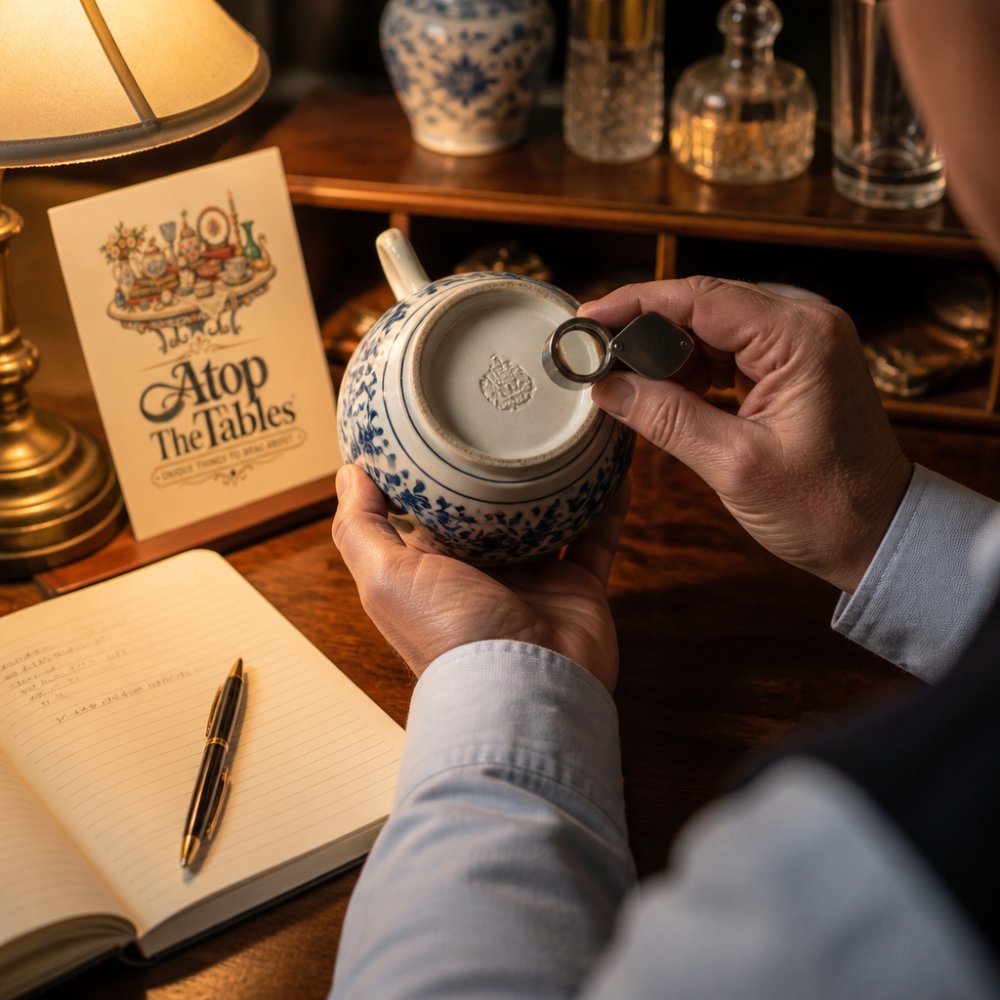
- Identify the maker. Look for impressed marks, printed backstamps, etched signatures, and paper labels. A mark narrows both origin and era.
- Date the piece. Date letters, registration numbers, and pattern records often pin production to a specific year.
- Grade the condition. Check for chips, cracks, crazing, repairs, and loss of decoration. Condition drives the multiplier more than any other factor.
- Establish rarity. Compare your version against the standard production run: unusual colorways, short-run patterns, and early examples sit at the top.
- Pull comparable sales. Look at realized prices, not asking prices. Asking prices are wishes.
Documentation lifts value in ways buyers underestimate. Our Harrach Islamic Revival enameled glass vase, made circa 1880 to 1895, comes with a signed 15-page research archive covering the attribution, museum references, and factory history. That file turns an attractive object into a documented one, and documented pieces are easier to sell and easier to price.

Vintage Collectibles Worth Money: What Separates the Valuable from the Ordinary
The vintage collectibles worth money share four traits: a known maker, a documented date, strong condition, and a design that collectors actively pursue. Everything else is decoration. Plenty of old things are charming.
| Trait | Raises Value | Holds Value | Weakens Value |
|---|---|---|---|
| Maker | Named factory, documented | Attributed, unsigned | Unmarked, unknown |
| Date | Marked year or date letter | Era-typical style | Uncertain period |
| Condition | No chips, cracks, or repairs | Minor expected wear | Restoration or loss |
| Rarity | Short run or unusual colorway | Standard production | Common pattern |
| Provenance | Estate or auction paper trail | Verbal history | None |
A Wedgwood blue Jasperware open salt cellar from 1867 with an impressed mark and date letter V is a clean example of the top row: named maker, exact year, and a form collectors actively seek.

How Collectible Condition and Value Move Together
Collectible condition and value move in lockstep, and the movement is not linear. A hairline crack can cut value far more than its visual size suggests, because collectors price on the assumption that damage worsens. Flaws that are expected for an era, like light silverplate oxidation on a piece more than 150 years old, cost far less than flaws that signal abuse.
The pre-purchase condition check
Run these checks in order, in good light, before money changes hands:
- Structure. Flex the piece gently. Look for wobble, separation at joints, and repairs that have failed. A stable repair is acceptable; a failing one is a future cost.
- Surface. Check for chips, cracks, crazing, and loss of decoration. Crazing is a network of fine glaze cracks; it matters enormously in porcelain and barely at all in pressed glass.
- Repairs and restorations. Look for color mismatches, overspray, and fills that catch the light differently. Ask directly whether the piece has been restored, and get the answer in writing.
- Upholstery and soft parts. If the piece has textile components, check for fading, thinning, and odor. Replacement is often the largest single cost in a restoration.
- Pests and storage damage. Look for frass, holes, and musty odor. These signal conditions that may have spread to other pieces.
- Materials and finishes.
Grade honestly and price accordingly
- Excellent: no chips, cracks, crazing, or repairs; original surface intact
- Good: minor expected wear consistent with age; decoration well defined
- Fair: visible chips, loss of decoration, or old restoration
Condition grading is category-specific. Learn the standard for your category before you apply it, and photograph every flaw before you negotiate. A seller who documents flaws is easier to trust than one who claims none exist.
Restoration effort versus value
Not every flaw is worth fixing. Cleaning and stabilization usually preserve value; aggressive refinishing often destroys it, because collectors pay for original surface. Before commissioning work, ask whether the restoration will raise the piece's market value by more than it costs, and whether the work will be reversible. Reversible conservation is almost always the safer choice.
Do not buy a piece with active pest damage or a failing structural repair unless you have priced the remedy. The purchase price is only part of the cost.
Vintage Collectibles Market Trends: What Buyers Should Watch
Vintage collectibles market trends reward attention more than prediction. Watch three signals: which categories younger buyers are entering, which patterns are completing in private collections, and which makers are getting new reference literature.
The bigger shift is how people buy. Our Arabia Finland Helsinki Helsingfors vase is a good illustration: a mid-century Scandinavian piece with crisp transfer detail and no condition issues travels well and photographs beautifully, which is exactly what a wider market rewards.

Do not buy into a trend you cannot authenticate. Rising prices attract reproductions, and a copy bought at trend pricing has no floor when the trend cools.
The Sustainability Story Behind Lasting Value
Durability is the quiet half of the value story, and it is also the half that competitors usually wave at without explaining. A piece that has already survived a century has proven its materials and construction, and that proof is worth something to buyers who are tired of replacing things. But the environmental case for vintage collectibles is more specific than "reuse is good," and understanding the mechanism is what separates a real sustainability argument from greenwashing.
Harrach Islamic Revival Moroccan Enameled Glass Vase Bohemian Circa 1880 Rare →
The lifecycle math, stated honestly
Every object carries embodied impacts: the energy used to extract and process its materials, the emissions from manufacturing, the transport to market, and the eventual end-of-life cost.
That is the honest framing. It is not zero impact; it is avoided new production plus extended service life. Most practitioners find that the transport and cleaning burden of a pre-owned piece is small relative to the manufacturing burden of a comparable new one, but the exact ratio depends on material, weight, and distance. Rather than quote a single number, use a simple framework:
- Avoided new production: Did this purchase replace a new item that would otherwise have been manufactured?
- Extended product life: How many additional years of use does restoration or repair buy?
- Waste diversion: Would this piece otherwise have gone to landfill or recycling?
A piece that replaces a new purchase, gets repaired rather than replaced, and travels a short distance scores well on all four. A piece bought as a fifth decorative object, shipped across an ocean, and never used scores poorly.
Why repairability is the real sustainability lever
A piece that can be cleaned, re-glued, re-wired, or refinished keeps its place in a home instead of a waste stream.
This is also where the value argument and the sustainability argument converge. A documented, repairable piece holds value precisely because it can keep serving a purpose. The collector who pays a premium for condition is, whether they frame it this way or not, paying for longevity.
Responsible sourcing and avoiding greenwashing
The market now contains plenty of newly manufactured items marketed as vintage, reclaimed, or sustainable. Distinguish genuine reuse from marketing by checking for wear consistent with age, construction methods typical of the stated era, and documentation of prior ownership. A piece described as reclaimed should show evidence of prior use; a piece described as vintage should survive a maker's-mark and date check.
U.S. Federal Trade Commission Green Guides on environmental marketing claims
Do not accept "eco-friendly" as a substitute for provenance. The most defensible sustainability claim a vintage seller can make is the one backed by a mark, a date, and a condition report.
Building a Collection That Holds Its Worth
Build around a thesis, not a haul. Pick one or two categories, learn the makers and the marks, and buy the best example you can authenticate rather than several mediocre ones.
- Choose your category and learn its top three makers
- Buy reference material before you buy objects
- Set a per-piece budget and hold to it
Our Antique Majolica Grape Vine cake plate shows the principle at work: a marked Zell piece with strong relief and vibrant glaze, priced so a new collector can enter a category without overcommitting.
Collectors who want to learn a category properly before spending heavily on a single showpiece.
Frequently Asked Questions
What vintage collectibles are worth money?
Pieces with documented maker marks, early production dates, and intact original finishes tend to command the strongest prices. Early Wedgwood Jasperware table accessories, signed art glass, and scarce mid-century porcelain cityscape series all draw steady collector interest. Rarity matters, but so does documentation: an item with a clear attribution and provenance record is easier to price and easier to resell than an identical piece with no history. Condition also decides the final number, since chips, repairs, and missing relief decoration pull value down sharply.
How do rarity and condition affect a collectible's value?
Rarity sets the ceiling and condition sets where within that range a specific piece lands. A scarce vase with a hairline crack may sell for a fraction of an intact example, while a common piece in flawless condition rarely outperforms a rare one in comparable shape. Collectors weigh both together: production year, surviving quantity, original glaze or finish, and whether any restoration has been done. Always examine photos of the base, rim, and any repaired areas before you commit, and ask whether the piece has been refinished.
Does provenance make vintage collectibles more valuable?
Yes, and the effect can be substantial. A signed research archive, estate auction record, or published museum reference turns an attractive object into a documented one, which reduces buyer uncertainty and supports a higher asking price. Provenance also helps at resale, because the next buyer inherits the same paper trail. Pieces with no attribution depend entirely on the seller's description, so their prices stay lower and negotiate harder. When you compare two similar items, the one with written documentation usually justifies the premium.
How can you tell whether a vintage collectible has lasting demand?
Look for a defined collector base rather than a short-lived trend. Categories with active reference literature, maker marks that can be verified, and steady auction results tend to hold demand across decades. Watch whether comparable pieces sell consistently rather than spiking once and disappearing. Market trends shift, so avoid buying purely on a headline price. Instead, favor pieces that combine a recognized maker, a documented production year, and good condition, since those three factors keep a collectible liquid when fashions change.
The hardest part of collecting is not finding pieces; it is knowing which ones deserve your money. At AtopTheTables, we have spent more than 20 years sourcing from estates and auctions so every item arrives with its history intact: personally selected inventory rather than catalog-sourced stock, documented provenance on significant pieces, and unusual finds that defy standard categories. Explore the collection and start with a piece you can authenticate, value, and keep.
