
How to Style Vintage Mantel Clocks for a Balanced Display
Last Updated: November 4, 2026
Quick Summary
Style vintage mantel clocks by placing the clock first as the focal point, just off-center and roughly one-third of the mantel's width from one edge. Build three distinct heights around it, leave visible bare mantel between groupings, and keep one side lighter than the other.
- The clock should fill roughly one-third of the mantel's width.
- Leave at least 3 inches of clearance on each side of the clock.
- Aim for three distinct heights across the arrangement: tall, medium, short.
- Keep at least a hand's width of open surface between the clock and its nearest neighbor.
- On a mantel under about 48 inches wide, make the clock the only tall element.
Table of Contents
- Start With the Clock as Your Focal Point
- A Step-by-Step Method for How to Decorate a Mantel With a Clock
- Vintage Mantel Clock Decorating Ideas for Every Style
- Mantel Clock Display Ideas for Shelves, Consoles, and Small Rooms
- Safe Placement and Care While You Display
- Find a Clock With a Story at AtopTheTables
- Frequently Asked Questions
Start With the Clock as Your Focal Point
Vintage mantel clocks work best as the anchor of the whole arrangement, not as one more object in a crowd.
The piece itself is only half the story. The other half is how you set it.
Here is the part most guides skip: balance is not symmetry. A perfectly mirrored mantel often looks stiff. Slight unevenness reads warmer and more human.
Choosing a Vintage Mantel Clock Worth Styling
Look for three things: a solid case, a readable face, and a movement that still runs. Size matters too. A clock under 6 inches tall can vanish on a deep mantel, while an oversized one crowds everything else.
Check the door or bezel, the hands, and the back stamp. A maker's mark tells you the piece has a history you can trust.
Belleek Pottery history and backstamps
For a starting point, our Belleek Cashel Shamrock mantel clock shows what a documented piece looks like: Irish porcelain, a quartz movement, and a 7.5-inch frame.

Scale and Proportion: Sizing the Clock to the Mantel
A simple rule: the clock should fill roughly one-third of the mantel's width. Anything smaller gets lost. Anything larger takes over.
- Measure the mantel's width and depth first
- Leave at least 3 inches of clearance on each side
- Keep the tallest object within two-thirds of the wall height above the shelf
If you are comparing options, our Waterford Lismore crystal clock is a heavier piece in lead crystal.

A Step-by-Step Method for How to Decorate a Mantel With a Clock
A workable method needs a sequence, a few measurements, and a way to check the result.
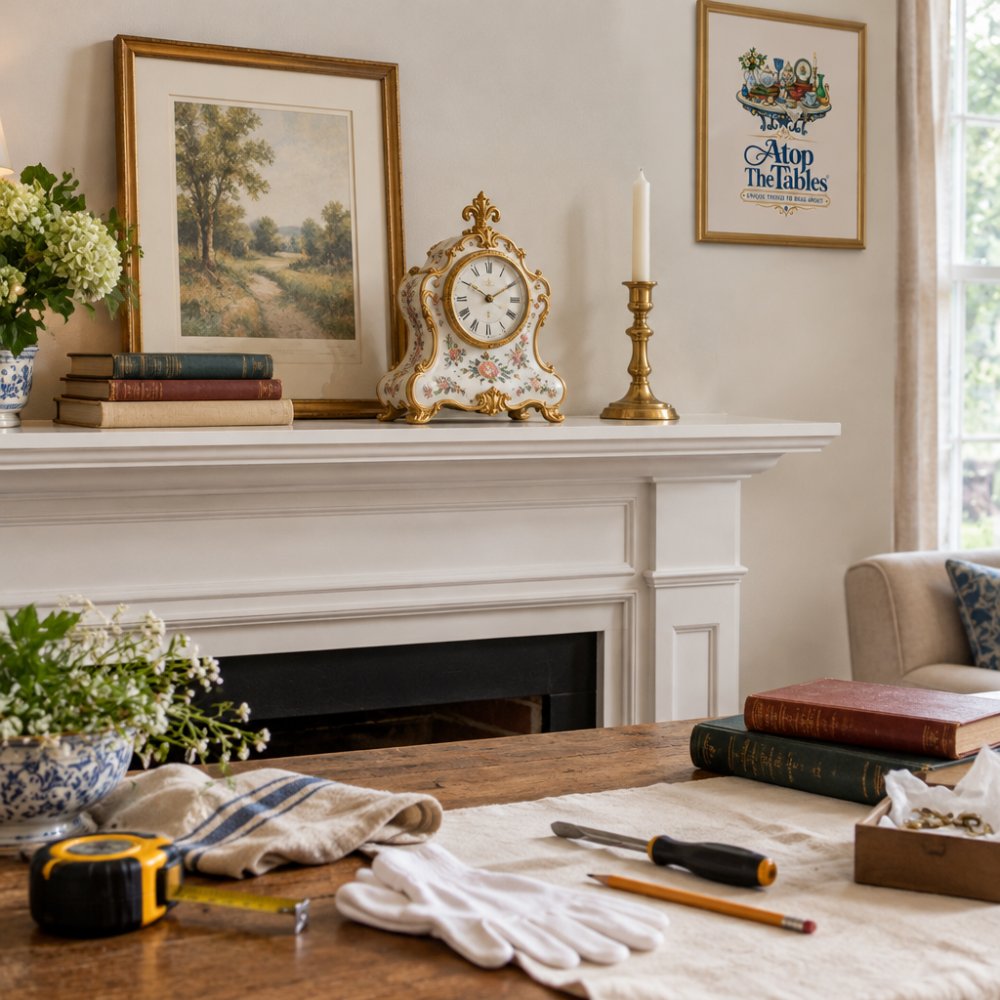
- Clear and measure. Empty the mantel, wipe the surface, and measure its width and depth. Write the numbers down; every later decision depends on them.
- Set the clock first. Place it just off-center, roughly one-third of the mantel's width from one edge. Do not add anything else yet.
- Establish the tallest secondary element. Lean a framed print or mirror behind and slightly beside the clock so its top edge sits a few inches above the clock's finial. This creates the vertical anchor the eye reads first.
- Vary height with a riser. Stack two or three hardcover books under one side of a smaller object, or use a low wooden riser. Aim for three distinct heights across the arrangement: tall, medium, short.
- Fill the open space sparingly. Tuck one small object, a brass candlestick, a small ceramic dish, a single stem in a bud vase, into the gap on the emptier side. Leave the other side lighter.
- Check the negative space. Step back and look at the gaps between objects. You want visible bare mantel between groupings, not a solid wall of things. A common pattern is to keep at least a hand's width of open surface between the clock and its nearest neighbor.
- Check the sightline. The eye should travel left to right without stopping on a crowded patch. If it snags, remove one object rather than adding another.
Watch out: stacking objects too tightly is a common mistake. Crowding can hide the focal point and make dusting harder.
A second common failure is treating the method as a fixed recipe. On a narrow mantel, drop step 3 and let the clock be the only tall element.
Vintage Mantel Clock Decorating Ideas for Every Style
Your clock should match the room, not fight it. A traditional space rewards symmetry and period details. A relaxed farmhouse room handles mismatched textures and softer color.
If you are new to this, our beginner's guide to vintage home decor walks through the basics before you commit to a full arrangement.
Traditional and Period-Inspired Arrangements
Traditional styling leans on symmetry and classical lines. Pair the clock with matching candlesticks, a gilt mirror, and a low bowl of dried stems. Keep the color palette tight: ivory, brass, deep wood.
Roman numerals and a glass face suit this look well. So does a wooden case with visible grain.
Belleek Cashel Shamrock Mantel Clock Irish Porcelain Quartz Clock 7.5 Inches →
Farmhouse Charm and Eclectic Mixes
Farmhouse and eclectic displays break the rules on purpose. Mix a porcelain clock with ironstone, woven baskets, and a chipped enamel pitcher. Vary the heights and let one object sit slightly forward.
- Use odd numbers of objects, usually three or five
- Repeat one material, such as brass or cream ceramic
- Keep at least one bare patch of mantel visible
Mantel Clock Display Ideas for Shelves, Consoles, and Small Rooms
Not every clock lives on a fireplace mantel, and the surfaces that do host one are rarely identical. The adjustments below cover the configurations most styling guides skip.
Narrow Mantels
On a mantel under about 48 inches wide, the clock should be the only tall element. Skip the leaning frame and use a low bowl or a single small object on one side. Keep the clock near the center rather than off-center; on a narrow surface, an off-center anchor leaves one side looking unfinished.
Deep Shelves and Built-Ins
A deep shelf (12 inches or more) swallows small objects. Pull the clock forward so its face sits near the front third of the shelf, and place a low stack of books behind it to fill the visual depth. On a shallow shelf (under 8 inches), skip the books entirely and lean a single small frame behind the clock at a slight angle.
No-Fireplace Rooms
A console table, sideboard, or dresser works as a substitute mantel. Treat the clock as the tallest object and center it, then flank it with lower pieces that step down in height on each side. Because a console is usually narrower than a mantel, use three objects total rather than five.
Mantels With a Television
When a television sits above or on the mantel, the clock becomes a secondary anchor. Place it to one side of the screen, not centered beneath it, and keep its top edge below the bottom of the screen so it does not compete. Use one low object on the opposite side to balance the weight, and avoid tall frames that block the screen or crowd the cables.
Small Rooms
In a small room, the mantel is often the only horizontal surface. Resist the urge to fill it. A clock, one small object, and a bare patch of surface read calmer than a full arrangement, and the negative space makes the room feel larger rather than emptier.
Smithsonian guidance on caring for antique clocks
Our guide to styling vintage art glass paperweights on office desks covers the same small-space logic for tighter surfaces.
Safe Placement and Care While You Display
Vintage mantel clocks are working objects, so placement and care go together.
- Dust the case with a soft dry cloth, never a wet one
- Wind or replace the battery on a schedule
- Lift the clock with two hands, never by the face or hands
- Keep crystal and porcelain away from the edge of the mantel
| Surface | Best Placement | Watch For |
|---|---|---|
| Fireplace mantel | Just off-center, anchored | Heat and soot |
| Console table | Tallest object, centered | Foot traffic bumps |
| Bookshelf | Centered, one frame behind | Overcrowding |
| Narrow ledge | Alone, no frame | Vibration and drafts |
Find a Clock With a Story at AtopTheTables
Our clocks are sourced from estates and auctions, and we document where they came from. A clock with a documented past gives your display something a new piece cannot.
Browse our curated vintage home gifts for one-of-a-kind finds to pair with your clock.
Frequently Asked Questions
How do you style a vintage mantel clock without making the mantel look cluttered?
Treat the clock as the anchor and cap the surrounding objects at three to five pieces. Keep the tallest item next to the clock shorter than the clock itself so it stays the focal point, and leave visible negative space between groupings. A common mistake is filling every inch of the mantel. If you can slide a hand between objects, the arrangement usually reads as intentional rather than crowded.
What should you put next to a mantel clock?
Pair it with items that vary in height and material: a leaning framed print, a short stack of books, a small vase, or a single decorative object with a matte finish. For vintage mantel clocks with a glass face and wooden or porcelain case, avoid placing anything directly in front of the dial so the clock face stays readable. Group objects in odd numbers and repeat one material, such as brass or dark wood, to tie the arrangement together.
Can a mantel clock be displayed on a shelf or console instead?
Yes. A mantel clock works well on a bookshelf, console table, or sideboard, and these spots often suit smaller rooms better than a fireplace. Apply the same proportion rule: the clock should take up roughly a third of the surface width, not half. On a narrow console, place the clock slightly off-center and balance it with one taller object on the opposite side. Keep it away from direct sun and heavy foot traffic.
How do you mix a vintage mantel clock with modern decor?
Let the clock be the one antique note in a clean, modern setting. Keep the surrounding pieces simple and low in pattern, use a neutral palette, and repeat one finish from the clock, such as brass hands or a dark wood tone, in a nearby object. Avoid surrounding a period clock with several other antiques unless you want a full traditional look, since too many aged pieces can read as heavy rather than curated.
Styling a mantel around a vintage clock is easier when the clock itself has real character and a story you can trust. At AtopTheTables, we hand-pick each piece, document its origin, and stand behind what we sell. Explore our collection of vintage clocks and home decor, and build a display that starts conversations.

