
Fenton Glass Lookalikes: 7 Patterns Collectors Mix Up
Last Updated: November 5, 2026
Quick Summary
Fenton glass patterns are easiest to confuse with lookalikes when collectors judge by color or overall impression, since marigold, amethyst, and green finishes appeared across many factories. Reliable identification compares the motif arrangement, the base starburst, and the rim treatment instead. Checking these mold details first settles most attributions.
- Separate the pattern from the glass type, color, and shape before comparing any two pieces.
- Check whether the motif runs in a continuous sweep or sits in isolated clusters.
- Count the points on the base starburst and note whether the rim is scalloped, smooth, or collared.
- Let mold details override the finish when color matches but the motif or base does not.
- Use a catalog only to confirm a candidate pattern you have already described from the piece itself.
Table of Contents
- Why Fenton Glass Patterns Get Confused With Other Makers
- Fenton Carnival Glass Patterns and Their Closest Lookalikes
- Feather and Heart Versus Other Marigold Carnival Patterns
- Dandelion and Oriental Poppy: Floral Patterns Across Makers
- A Visual Decision Guide for Identifying a Pattern by Its Features
- Using the Fenton Glassware Catalog to Verify Attribution
- Start Your Own Comparison With These Five Pieces
- Frequently Asked Questions
Why Fenton Glass Patterns Get Confused With Other Makers
A common question among collectors is whether a piece is Fenton, or something that only looks like it. Fenton glass patterns are among the most recognizable in American carnival glass, which is why so many lookalikes circulate.
Fenton glass patterns are easiest to confuse with other makers when a collector relies on color or general impression alone. Marigold, amethyst, and green finishes appeared across many factories, so the finish rarely settles the question.
The most useful habit is to compare the pattern itself rather than the overall look. Lay two pieces side by side and check the mold details: the spacing of the motifs, the way the lines terminate, and whether the design wraps the exterior or stops at the rim.
This guide walks through the pairs that cause the most confusion, then offers a visual decision approach and a catalog-based check.
Fenton Carnival Glass Patterns and Their Closest Lookalikes
Fenton's carnival glass was made in many patterns, and many share the same basic vocabulary of pinecones, feathers, geometry, and flowers. The challenge is that a pattern name tells you what a design depicts, not who made it. Two makers can produce a similar motif, and only the mold details show the difference.
When evaluating a suspect piece, collectors often start with three questions: does the motif match the Fenton version in arrangement, does the base or rim show the same finish, and does the weight and proportion feel consistent with the maker. A "no" to any one is a reason to look more closely before assuming attribution.
Pinecone Compared With Similar Pine and Cone Motifs
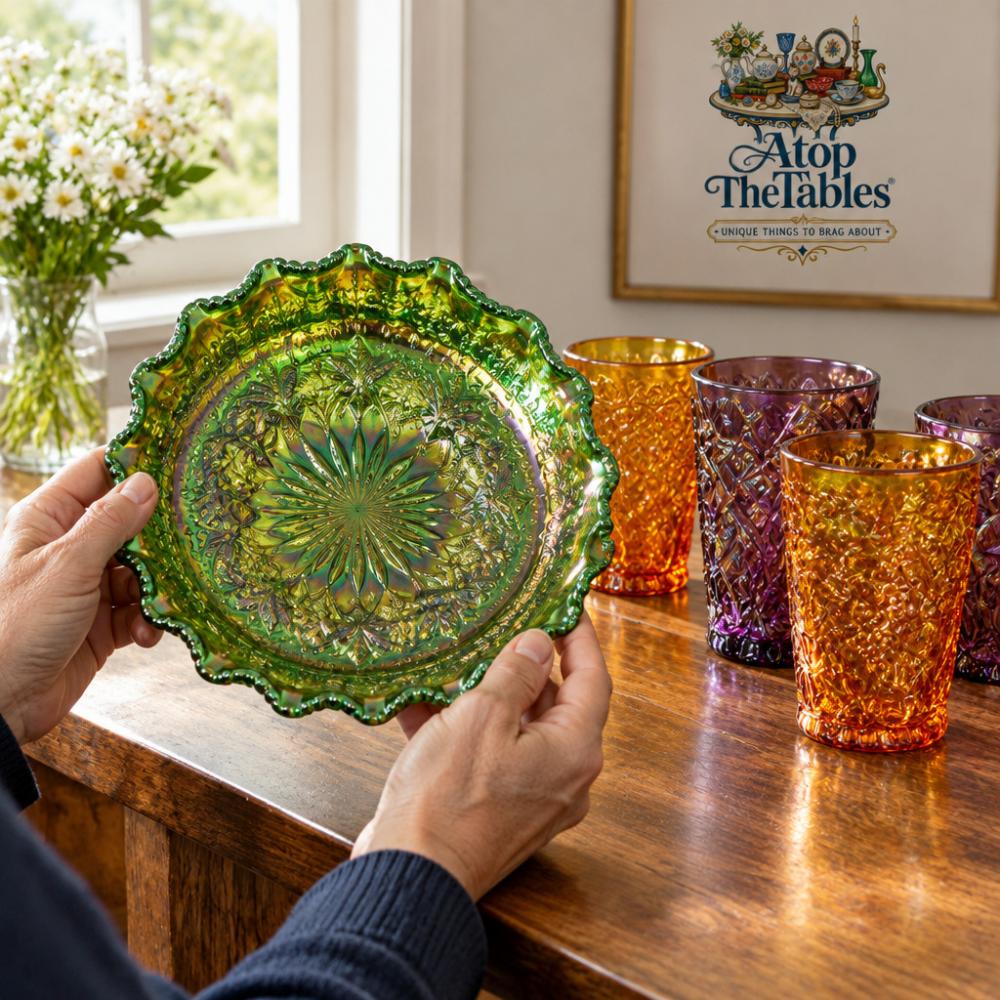
The Pinecone pattern is one of Fenton's most admired nature designs, and it is also one of the easiest to confuse with other pine-and-cone motifs. The Fenton Pinecone Green Carnival Glass Flat Plate, 6.25 inches, shows cascading pinecones and pine boughs around a central medallion, framed by a scalloped edge.

Many other makers used pine branches and cones, so compare the cones themselves.
Once you have checked the motif, look at the edge. The scalloped rim is part of this pattern's character, so confirm whether a similar-looking piece's rim matches before you decide.
Best for: collectors who want a green carnival plate with clear, nature-based detail. Skip if: you need an exact date or maker's mark, since the description above is based on the pattern and finish rather than a stamped identifier.
Diamond and Lace Compared With Other Geometric Carnival Designs
Diamond and Lace is a geometric pattern, and geometry is where many lookalikes hide. The Imperial Diamond and Lace Carnival Glass Tumbler in amethyst, 4 inches tall, shows diamond panels, lace-textured elements, and starburst medallions with a smooth collar at the rim.

Other makers produced diamond and panel designs too, so measure the repeat. In a geometric pattern, the spacing of the diamonds and the way the lace texture fills the gaps identify the design.
Compare it against any geometric piece you are considering, checking whether the lace detail appears between the diamonds in the same place. You can also view a Dugan Black Amethyst Carnival Glass Diamond Beaded Shell Tumbler to compare diamond geometry directly.
Best for: collectors building a geometric carnival set or studying Imperial's mold work. Skip if: you are looking for a flat plate or a bowl shape, since this is a tumbler.
The table below summarises the key identifying features of each pattern discussed, so you can compare the motif, base and rim at a glance.
| Pattern | Maker | Key feature to check |
|---|---|---|
| Pinecone | Fenton | Continuous cascading cones and boughs |
| Diamond and Lace | Imperial | Lace texture filling gaps between diamonds |
| Feather & Heart | Millersburg | Alternating feather panels and heart arches |
| Dandelion | Northwood | Raised sunflower-style blossoms and starburst base |
| Oriental Poppy | Northwood | Arched panels framing stylized poppies |
Feather and Heart Versus Other Marigold Carnival Patterns
Marigold carnival glass is one of the most common finishes, and it is the color where confusion is most frequent.
The Millersburg Feather & Heart Marigold Carnival Glass Tumbler, 4 inches, is finished in marigold iridescence over clear glass, with gold, orange, and pink tones. The feather panels sit above heart-shaped arches framed by starburst motifs.

Marigold alone does not indicate a maker. Plenty of other patterns were produced in the same finish, so color is only the starting point. Focus on the arrangement of the motifs and how the pattern meets the rim.
Best for: collectors who want a marigold tumbler with bold, recognizable geometry. Skip if: you are shopping by color alone, since many marigold patterns look similar at a glance.
Dandelion and Oriental Poppy: Floral Patterns Across Makers
Floral carnival designs are where lookalikes get especially tricky, because many makers used flowers and leaves. Two carnival glass tumblers show how different floral patterns can be within the same general style.
Fenton Pinecone Green Carnival Glass Flat Plate 6.25 Inches Antique Vintage →
Our Northwood Dandelion Marigold Carnival Glass Tumbler in olive green, 4 inches, features raised sunflower-style blossoms, leaves, and flowing stems wrapped around the exterior. The interior carries the floral motif through the translucent green glass, and the base has a crisp sixteen-point starburst.
Our Northwood Oriental Poppy Black Amethyst Carnival Glass Tumbler, 4.5 inches, offers a different floral vocabulary. Arched panels frame stylized poppy blossoms and foliage, and the black amethyst base appears nearly black in ordinary light, then shows electric blue, violet, and magenta under reflected light. The contrast between these two Northwood patterns is a useful reminder that a single maker can produce very different floral designs.
Across makers, the test is the same: match the flower shape, the leaf structure, and the way the design fills the surface. A similar flower in a different arrangement is a signal to keep looking.
Best for: collectors who want two distinct floral directions from the same maker. Skip if: you need a matching set, since these two tumblers are different patterns and bases.
A Visual Decision Guide for Identifying a Pattern by Its Features
Most guides tell you to "look closely at the pattern." That advice is useless without a fixed order of inspection, because the eye jumps to color and finish first and stops there.
Step 1: Separate pattern from glass type, color, and shape. These are four independent questions, and mixing them is the most common source of misattribution. The pattern is the designed motif pressed into the mold. The glass type is the material and surface treatment, such as carnival (iridized) or opalescent. The color is the base tone under the iridescence, such as marigold, amethyst, or green. The shape is the form, such as a plate, tumbler, bowl, or compote.
Step 2: Map the motif's arrangement. Note three things: does the design repeat evenly around the piece, does it wrap the exterior or stop at a panel line, and where does it terminate at the rim and base? Fenton's nature patterns tend to run in a continuous sweep, while many lookalikes place motifs in isolated clusters. On geometric patterns, measure the repeat: the spacing of diamonds or panels and how texture fills the gaps are more diagnostic than the motif itself.
Step 3: Read the base and the rim. These are where makers diverge most even when the main motif is close.
Step 4: Check the mold details. Run a fingertip along the motif.
Step 5: Judge the finish last. Iridescence shifts with the base color and the lighting, so it is the least reliable first impression and the most reliable last check.
Using the Fenton Glassware Catalog to Verify Attribution
A catalog is a confirmation tool, not an identification tool. It works best when you already have a candidate pattern and a written record of the features from the decision guide above.
Take your five feature notes (pattern, glass type, color, shape, and the base and rim details) and match them one at a time against the catalog entry. A strong attribution needs agreement on the motif arrangement, the base treatment, the rim treatment, and the finish. If three of the four agree and one is ambiguous, treat the attribution as probable but unconfirmed. If the motif matches and the base or rim does not, you are probably looking at a different maker's piece that borrowed the motif.
Why lookalikes exist in the first place. Pattern designs were shared, adapted, and reissued across the early twentieth-century glass trade, which makes appearance alone unreliable.
Where the catalog stops helping. A catalog entry describes a pattern and a finish; it does not certify a specific piece.
A practical sequence for a suspect piece. First, complete the five-feature record. Second, find the closest catalog entry and note every point of agreement and disagreement. Third, re-examine the piece at the points of disagreement, since that is where a lookalike reveals itself. Fourth, if the disagreement holds, stop trying to force the attribution and compare against other makers' patterns instead.
For the pieces in this guide, the listings describe the maker, pattern, color, dimensions, and condition, which gives you a four-point comparison to run against a piece in hand. Read the full specifications, then check them against what you actually see rather than against what you hope to see.
Start Your Own Comparison With These Five Pieces
Comparing lookalikes is easiest when you have reference points, so the following five pieces cover the main directions discussed in this guide:
- Fenton Pinecone Green Carnival Glass Flat Plate, 6.25 inches ($56.78): a nature-based green carnival reference.
- Imperial Diamond and Lace Carnival Glass Tumbler, Amethyst, 4 inches ($41.58): a geometric reference with lace texture.
- Millersburg Feather & Heart Marigold Carnival Glass Tumbler, 4 inches ($75.78): a bold marigold geometric reference.
- Northwood Dandelion Marigold Carnival Glass Tumbler, Olive Green, 4 inches ($56.78): a raised floral reference.
- Northwood Oriental Poppy Black Amethyst Carnival Glass Tumbler, 4.5 inches ($89.08): a dramatic floral reference in black amethyst.
Handling these five side by side will show you how much the pattern, rather than the color, tells you about a piece. Begin with the Fenton plate, then compare each tumbler against the criteria in the decision guide above. Once the differences become obvious, you will be far better equipped to spot a lookalike on your own.
Frequently Asked Questions
What is the most sought after Fenton glass?
Fenton carnival glass in green and marigold finishes is among the most collected, especially pieces with clear, crisp molding and bright, even iridescence. Collectors also look closely at Fenton's early Pinecone and Hobnail-style work. Condition drives value as much as pattern: chips, cracks and repairs lower prices, and a bright, unworn finish raises them. Compare recent sold listings and reference guides before assuming any piece is rare, since demand and prices shift over time.
What glass patterns look similar to Fenton patterns?
Several makers produced carnival and pressed glass with overlapping motifs. Northwood, Imperial and Millersburg each made floral and geometric designs that can resemble Fenton work at a glance. The clearest way to separate them is to compare the mold detail, the base design and the color of the iridescence. Pattern names alone are not reliable, because the same motif often appeared across several companies and in later reissues.
How can I tell whether a glass piece is Fenton or a similar pattern?
Start with the base and the mold lines. Many Fenton pieces carry a maker's mark, usually on the base, though marks can be worn or absent. Compare the pattern's exterior and interior sides, check the shape and rim, and note the glass color and finish. Then cross-check the pattern against a Fenton catalog or a reputable reference. If a mark is missing, treat the attribution as a probable match and say so when you describe the piece.
What details should I compare when identifying vintage glass patterns?
Compare the pattern itself, the glass type, the color and the shape as four separate questions. A pattern is the decorative design, while the glass type describes the material and process, such as pressed or carnival. Color and finish, including the iridescence, help narrow the maker. Shape tells you whether the object is a tumbler, plate, bowl or compote. Keeping these four categories apart makes it much easier to match a piece to a catalog entry.

