
7 Best Vintage Teapots for Collectors to Hunt Down
Last Updated: November 3, 2026
Quick Summary
The best vintage teapots for collectors combine a readable maker's mark, a form that still pours cleanly, and decoration not rubbed away by handling. Top picks include an Oscar Gutherz Limoges porcelain teapot, a signed Ken Edwards Tonalá piece, and a retailer-marked Charles Ahrenfeldt chocolate pot.
- Turn the pot over first and photograph the maker's mark in good light.
- Light wear to gold trim is normal and does not sink value like a chip does.
- A teapot without its original lid is a different object to most collectors.
- Compare sold prices rather than asking prices, and record a range.
- Wash antique porcelain by hand in warm water with mild dish soap, never in a dishwasher.
Table of Contents
- What Makes a Vintage Teapot Worth Collecting
- Quick Comparison: Seven Vintage Teapots at a Glance
- 1. Oscar Gutherz Limoges Porcelain Teapot: The French Classic
- 2. Ken Edwards Tonala Pottery Teapot: Mexican Folk Art Charm
- 3. Charles Ahrenfeldt Limoges Chocolate Pot: The Retailer-Marked Find
- 4. Jonal Puss'n Boots Figural Teapot: Whimsy With a Story
- 5. Fitz and Floyd 1989 Santa Teapot: Holiday Collecting
- How to Identify a Vintage Teapot Before You Buy
- Vintage Teapot Care, Storage, and Display
- How Much Are Antique Teapots Worth?
- Start Your Collection With Pieces That Tell a Story
- Frequently Asked Questions
What Makes a Vintage Teapot Worth Collecting
A vintage teapot is worth collecting when its maker, form, decoration, and condition survive intact enough to reveal when and where it was made.
The best vintage teapots are not always the oldest or most ornate, they are the ones where the story is verifiable. A Limoges pot with a legible green mark, a Tonalá piece signed by its maker, a retailer-stamped chocolate pot from a named Philadelphia jeweler: each gives you a paper trail.
Here is how to judge a teapot before you buy it.
Selection Criteria: Marks, Form, and Condition
Maker's marks come first. A hand-applied signature, an impressed copyright line, or a printed factory stamp tells you who made the piece and roughly when.
Form matters next. Check that the spout is unbroken where it meets the body, that the lid sits flush, and that the handle has no hairline cracks at its joints.
Condition is the third filter. Light wear to gold trim is normal on antique porcelain and does not sink value the way a chip or a repair does.
Quick Comparison: Seven Vintage Teapots at a Glance
Five teapots anchor this shortlist, each representing a different collecting lane: French porcelain, Mexican folk pottery, retailer-marked American luxury goods, figural whimsy, and holiday ceramics. Prices below are the asking prices on our listings.
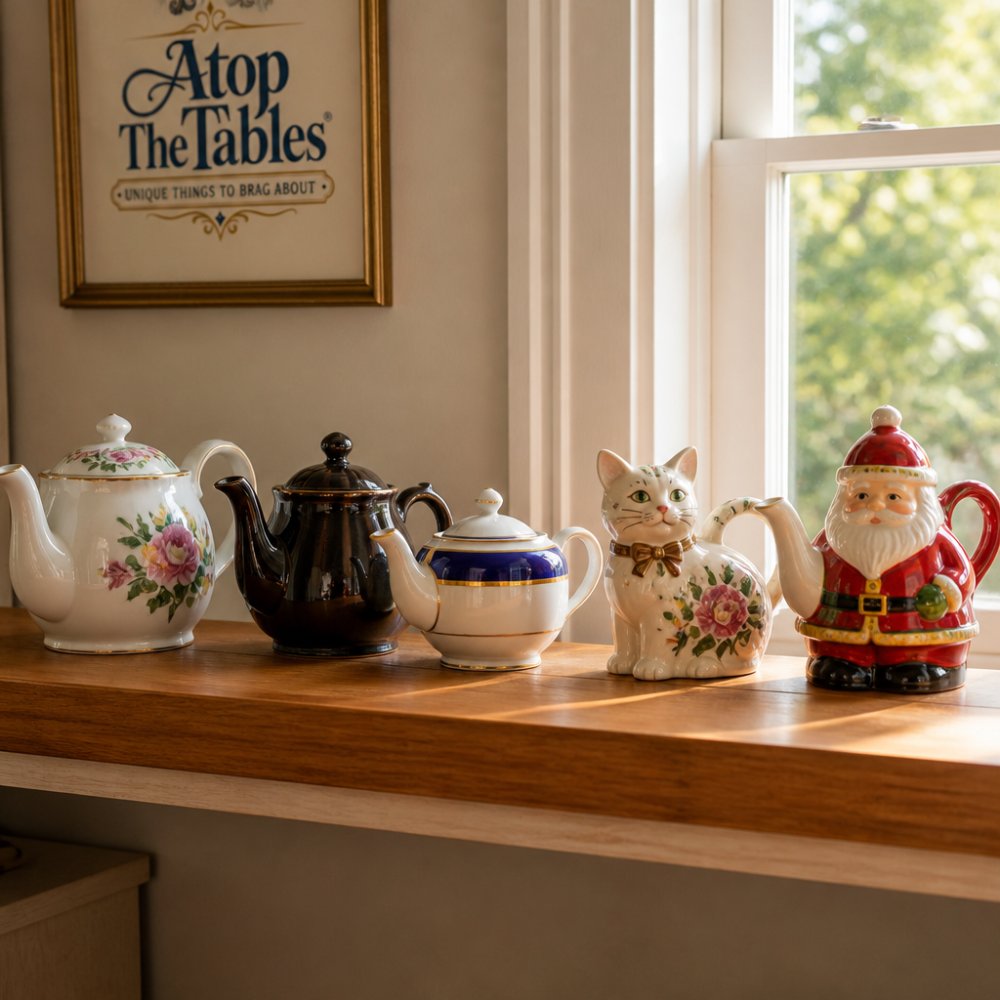
| Teapot | Maker | Origin | Price | Best For |
|---|---|---|---|---|
| Oscar Gutherz Limoges | Oscar Gutherz | France | $79.82 | Fine porcelain collectors |
| Ken Edwards Tonalá | Ken Edwards | Mexico | $44.77 | Folk art and pottery displays |
| Ahrenfeldt Chocolate Pot | Charles Ahrenfeldt | France | $67.29 | Provenance and retail history |
| Jonal Puss'n Boots | Jonal | China | $27.77 | Figural and whimsical collecting |
| Fitz and Floyd Santa | Fitz and Floyd | United States | $17.82 | Holiday collecting |
The two Limoges pieces carry the highest asking prices, while the figural and holiday pots sit at entry level. That spread reflects how the market values documentation: a marked French porcelain pot has a name, a period, and an export history attached, while a 1980s holiday ceramic has a date stamp and charm but a much shorter story.
1. Oscar Gutherz Limoges Porcelain Teapot: The French Classic
The Oscar Gutherz Limoges teapot is a strong choice for a new porcelain collector. It has everything a Limoges should: hand-painted florals in soft pinks, blues, and greens, gold trim on the sculptural handle and curved spout, a fitted lid, and a capacity of roughly seven cups.
Oscar Gutherz was one of the notable Limoges manufacturers active in the late 1800s, producing floral-decorated, gold-embellished porcelain for export.
Best for: collectors building a French porcelain shelf who want a marked, display-ready piece at under $80.
See the Oscar Gutherz Limoges teapot

2. Ken Edwards Tonala Pottery Teapot: Mexican Folk Art Charm
Ken Edwards pottery brings a different energy to a collection, and this Tonalá teapot shows why the maker has a following.
The underside bears the hand-applied "KE Mexico" signature plus a decorative mark, exactly what you want on a Tonalá piece. It measures about 7.75 inches long including spout and handle, 5 inches wide, and 6.5 inches high with the lid, weighing 1 pound 10 ounces.
Best for: collectors who want handmade character and a signed piece rather than formal porcelain.
View the signed Ken Edwards Tonalá teapot

3. Charles Ahrenfeldt Limoges Chocolate Pot: The Retailer-Marked Find
Retailer marks are the quiet secret of antique porcelain collecting. This Charles Ahrenfeldt Limoges chocolate pot was made in France and retailed by J.E.
The body is ivory porcelain with rich cobalt blue bands, hand-painted floral garlands, and gilt detailing on the spout, handle, and finial.
Best for: collectors of fine French porcelain and anyone drawn to American retail history.
See the Ahrenfeldt chocolate pot listing

4. Jonal Puss'n Boots Figural Teapot: Whimsy With a Story
Figural teapots are their own collecting category, and this Jonal Puss'n Boots piece is a textbook example.
The base is marked "TEA TIME CLASSICS / Puss'n Boots / by JONAL / China." It measures approximately 9.5 inches long, 6 inches wide, and 9 inches high, weighing about 38 ounces. We found no chips, cracks, repairs, or crazing on inspection, and the matching lid is included.
Best for: whimsical and cat-themed collections, or a kitchen shelf that needs one conversation piece.
View the Jonal Puss'n Boots teapot
5. Fitz and Floyd 1989 Santa Teapot: Holiday Collecting
Holiday ceramics reward collectors who care about dates, and this Fitz and Floyd Santa teapot wears its date on the base: "© FF 1989 40 OZ." The hand-painted Old World Santa holds a teddy bear, with a twisted red-and-gold handle and sculptural accents across a 40-ounce body.
It measures approximately 11 by 7 by 7 inches and weighs 1 pound 14.3 ounces. Overall condition is very good vintage with bright colors and a glossy finish; there is one small chip under the spout, visible in the close-up photos and priced accordingly. It displays beautifully from all sides.
Oscar Gutherz Limoges Teapot Floral Gold Trim 7 Cup France Antique Porcelain →
Best for: holiday collectors who want a dated, functional serving piece at an entry-level price.
See the 1989 Fitz and Floyd Santa teapot
How to Identify a Vintage Teapot Before You Buy
Identification starts with the base. Turn the pot over first and photograph the mark in good light. A printed factory stamp, an impressed copyright line, or a hand-applied signature each narrows the maker and era. If the seller cannot show you the underside, ask.
Then work through a short checklist:
- Mark: legible, correctly spelled, and consistent with the maker's known marks
- Form: spout unbroken at the joint, lid flush, handle free of hairlines
- Decoration: hand-painted detail under slight magnification, not a printed transfer
Reading the Mark: A Practical Method
Most collectors learn marks by working backward from a known piece: country of origin wording first, then maker name, then date code or registry number, then decorator's signature.
Look at how the mark was applied. Impressed marks and printed marks can be told apart by touch and by looking under raking light.
Registry and pattern numbers are the second lever.
Dating the Piece
Dating is inference, not certainty. Three signals usually agree before a date is trustworthy: the mark, the form, and the decoration. A mark reading 1890s paired with a form and glaze palette that only appear after 1920 is a red flag.
Watch out: a seller who describes a piece as "perfect" without showing the base or the spout rim is telling you nothing. Ask for close-ups of both, plus the handle joint, before you pay.
Spotting Reproductions and Misattribution
Reproduction teapots usually fail on one of four points: the mark is too crisp and modern for the claimed age, the decoration is a printed transfer imitating hand painting, the weight is wrong for the material, or the wear pattern is artificial. Genuine age wear is uneven and follows handling; artificial wear is sanded or chemically dulled and looks uniform. Crazing in old glaze is fine and irregular; a reproduction may show none or a sprayed-on crackle that sits on the surface.
Misattribution is more common than outright forgery. A piece may carry a retailer's stamp and be described as the manufacturer's work, or a factory may have used a mark long after the original owner sold the business.
For broader guidance on marks and dating, the Smithsonian's ceramic and glass care guidance covers handling and storage of historic ceramics, and the Library of Congress preservation resources explains how to document condition for a collection record.
Vintage Teapot Care, Storage, and Display
Care is where good collections are protected or ruined. Wash antique porcelain by hand in warm water with a mild dish soap, never in a dishwasher, and never with an abrasive pad. Dry immediately with a soft cloth, and let the piece air completely before it goes back on the shelf.
Storage rules we follow:
- Line shelves with felt or shelf paper to absorb vibration
- Never stack teapots; lids crack under weight
- Keep pieces out of direct sun, which fades hand-painted decoration over years
For display, rotate pieces seasonally so nothing sits in harsh light year-round. A glass-front cabinet keeps dust off without sealing in moisture.
How Much Are Antique Teapots Worth?
Value comes down to four factors: maker, condition, completeness, and provenance. A marked Limoges pot in very good condition with its original lid will always outperform an unmarked piece of similar age. Retailer stamps, estate paperwork, and dated bases can add to a piece's appeal because they make identification easier.
Grading Condition Before You Price
Condition is the factor collectors most often misjudge, so grade it in writing before you compare prices. A workable scale:
- Mint: no wear, no repairs, original lid, decoration crisp
- Excellent: light age-appropriate wear only, no chips, cracks, or repairs
- Very good: minor wear to gilt or glaze, one small flaw disclosed and photographed
Condition steps down the scale and affects value, often most sharply between very good and good. A single chip under a spout can move a price meaningfully, as our Fitz and Floyd listing reflects. Crazing alone usually does not sink value on antique porcelain, but it does on pieces sold as pristine. Missing lids and replacement parts are the quiet killers: a teapot without its original lid is a different object to most collectors, and a mismatched lid is worse than none.
Using Sold Prices, Not Asking Prices
Comparable sold prices are the honest benchmark. Look at what similar marked pieces have actually sold for, not what sellers are asking, and adjust for condition differences. The method that holds up:
- Collect at least five sold results for the same maker, form, and approximate period.
- Discard outliers at both ends, including one unusually high result driven by provenance.
- Grade each comparable on the scale above and adjust the subject piece up or down to match.
- Weight recent sales more heavily than older ones, because demand shifts.
- Record the range, not a single number, and treat asking prices as ceiling signals only.
Asking prices and realized sold prices can differ, so compare sold results where you can find them. That gap is the collector's margin.
Provenance and Demand
Provenance adds value when documented, not asserted. Estate paperwork, auction records, and dated bases shorten identification and reassure the next buyer, which is why they carry a premium. Demand matters too: figural and holiday categories move quickly at entry-level prices, while formal porcelain depends on a narrower pool of buyers who pay for condition and marks.
For a deeper grounding in how museums assess and document historic ceramics, the National Park Service museum collections guidance outlines condition reporting standards worth borrowing for your own records.
Start Your Collection With Pieces That Tell a Story
The teapots worth hunting are the ones you can identify, describe, and pass on with confidence. Every piece in this shortlist comes with a readable mark, honest condition notes, and a documented source, each sourced through estates and auctions rather than a catalog.
AtopTheTables has been curating vintage collectibles since 2003, with personally selected inventory and careful packaging for fragile ceramics. Explore the collection and find the teapot that starts your next shelf.
Frequently Asked Questions
Are vintage teapots worth anything?
Value depends on maker, age, condition, and completeness. A marked Limoges porcelain teapot in very good antique condition with intact gold trim can command far more than an unmarked novelty pot, while figural and holiday teapots from recognized makers like Fitz and Floyd hold steady collector demand. Condition matters most: chips, cracks, repairs, and heavy gilt wear all reduce value, so check the spout, handle edges, and base rim closely before buying.
How can you identify a vintage teapot?
Start with the underside. Maker's marks, country of origin, impressed dates, and retailer stamps are the fastest identifiers. On the Oscar Gutherz Limoges teapot, the maker mark points to late 19th to early 20th century French production, while the Ken Edwards pot carries a hand-applied KE Mexico signature. Then examine form, glaze crazing, and gilt wear patterns, which age differently than modern reproduction finishes.
Which marks should collectors look for on a teapot?
Look for a maker name, a country of origin, and any retailer stamp. A green Charles Ahrenfeldt Limoges mark combined with a J.E. Caldwell Philadelphia retailer stamp signals both French manufacture and an upscale American retail history, which adds collector interest. Impressed dates like the copyright and year on the Fitz and Floyd Santa teapot help date the piece precisely. Always compare the mark against known references before paying a premium.
How do you care for a vintage teapot?
Hand wash only with mild soap and lukewarm water, and never put gilded porcelain or glazed pottery in the dishwasher. Dry immediately with a soft cloth to protect gold trim. Store lids separately or cushioned, and display pieces away from direct sunlight to prevent fading. For figural and holiday teapots, dust with a soft brush rather than a wet cloth to preserve painted detail.

