
Why Curated Vintage Costs More: Hidden Costs Explained
Table of Contents
- Why Curated Vintage Costs More: The Hidden Costs Behind Every Piece
- Curated Vintage vs. Thrift Store Finds: What's the Real Difference?
- Scarcity, Rarity, and the Economics of Supply
- Garment Restoration and Repair: The Costs Most Buyers Never See
- Bone China Care and the Value of Proper Handling
- Vintage Glassware Authentication: Why Verification Adds Cost
- Overhead Costs, Online Marketplace Inflation, and Geographic Price Variations
- Conclusion: Why the Premium Is Worth Paying
- Frequently Asked Questions
Last Updated: October 2, 2026
Why Curated Vintage Costs More: The Hidden Costs Behind Every Piece
Anyone who has stood in a thrift store aisle holding a two-dollar teacup and then browsed an online vintage shop listing a similar piece for far more has asked the same question: why does curated vintage costs more?
The gap between a thrift store find and a curated piece is not about the object itself.
Curated Vintage vs. Thrift Store Finds: What's the Real Difference?
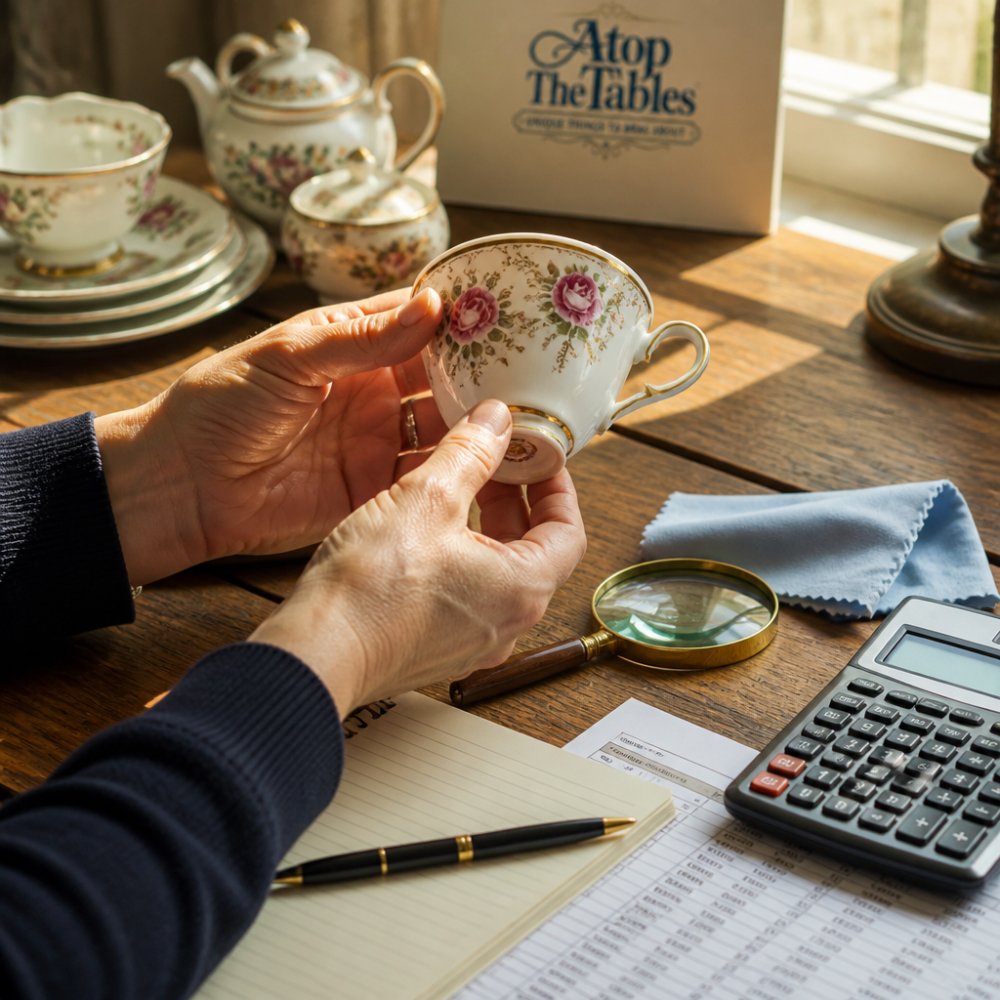
The real difference is labor. A thrift store sells whatever arrives in a donation bin, unsorted and unverified. A curated vintage dealer builds an inventory through deliberate sourcing, then spends time on each piece before it can be sold. That time is the product.
The labor cost of sourcing and curation
Sourcing is the most underestimated line item in vintage retail. A dealer may visit dozens of estate sales, auctions, and private collections to find a handful of pieces worth listing. Many trips yield nothing. The cost of those empty trips does not disappear; it gets absorbed into the pieces that do sell.
Curation adds a second layer. Someone has to research the maker, date the piece, identify the pattern or edition, and decide whether it fits the shop's aesthetic. A common mistake among new buyers is assuming this research is quick. In practice, dating a single piece of vintage glassware or confirming a china pattern can take an hour or more of cross-referencing reference guides and maker marks.
Quality control and authentication processes
Quality control is where curated sellers separate themselves from casual resellers. Every piece is inspected for chips, cracks, crazing, and restoration, and anything questionable is either repaired, disclosed, or rejected. Authentication matters most for glassware and ceramics, where reproductions are common and marks can be misleading. A dealer who verifies a piece before listing it absorbs the cost of that verification, but the buyer gets certainty instead of a gamble.
Scarcity, Rarity, and the Economics of Supply
Scarcity drives vintage pricing more than condition or brand. A piece produced in a limited run, or one that survived decades without breakage, simply cannot be replaced at will. When a dealer finds a rare piece, they are pricing a one-of-a-kind object, not a restockable SKU.
This is the part most buyers miss. In mass-produced retail, supply can be increased to meet demand. In vintage, supply is fixed and shrinking.
Garment Restoration and Repair: The Costs Most Buyers Never See
Restoration is the single most misunderstood line item in the vintage trade, and it is where the gap between a thrift-store price and a curated price is widest. Textiles, ceramics, and glass arrive with damage that must be addressed before a piece can be sold honestly. A dealer has three choices: sell it as-is with full disclosure, restore it, or discard it. Restoration is expensive, and it requires skill most sellers do not have in-house.
The economics are unforgiving, and they follow a predictable sequence. A piece that arrives dirty first goes through professional cleaning, textile conservation washing, gentle stain treatment, or hand detailing for ceramics and glass.
Each stage carries its own failure risk. Cleaning can lift a dye or dull a finish. Stabilization can leave visible evidence if done poorly. Repair can reduce value if a buyer later judges it heavy-handed.
This is the part of the supply chain that stays invisible. A dealer who restores ten pieces to get three sellable ones has to recover the cost of all thirteen transactions, the ten restorations, the three sales, and the labor on every rejected attempt, from the three that reach a listing page. Buyers who complain that curated prices are high rarely see the pieces that were rejected along the way, and they rarely see the hours spent on pieces that never sold at all.
There is also a skill premium. Conservation-grade cleaning and invisible repair are trades, not hobbies.
Harmony Kingdom 2002 Reference Guide Collector Book Archive Copy →
Bone China Care and the Value of Proper Handling
Bone china care is not just a maintenance habit; it is a value preservation strategy. Bone china is prized for its translucency and delicate ring, but that delicacy means chips and cracks are common and costly.
A collector who stores bone china stacked without padding, or runs it through a dishwasher, will eventually damage pieces that took years to find. Dealers know this, which is why many invest in proper packing materials and storage conditions.
Vintage Glassware Authentication: Why Verification Adds Cost
Vintage glassware authentication is the process of confirming that a piece was made by the maker and in the era claimed, rather than being a later reproduction or a misattributed piece.
Verification takes time, and time costs money. A dealer who authenticates glassware before listing it is protecting the buyer from expensive mistakes. Reproductions of popular patterns are common, and an unverified piece sold as original can destroy a buyer's trust.
Overhead Costs, Online Marketplace Inflation, and Geographic Price Variations
Overhead costs are the quiet multiplier on every curated price. Rent or storage, insurance, packing materials, photography, listing fees, and payment processing all add up before a single piece sells.
The middleman chain is where most buyers lose the thread.
| Cost Layer | What It Covers | Why It Raises the Price |
|---|---|---|
| Sourcing labor | Estate sales, auctions, travel, empty trips | Unproductive trips still cost time and money |
| Middleman margins | Estate commissions, auction fees, picker markup | Each hand in the chain adds cost before curation |
| Authentication | Marks, patterns, production history | Verification takes expert hours |
| Restoration | Cleaning, stabilization, repair, re-inspection | Rejected pieces are a total loss |
| Overhead | Storage, insurance, packing, photography, listing fees | Fixed costs spread across finite inventory |
| Marketplace demand | Online competition for rare pieces | Higher demand, fixed and shrinking supply |
Online marketplace inflation has pushed prices up across the category. As more buyers shop vintage online, demand for desirable pieces has risen faster than supply, and prices have followed.
The sustainability angle is the part competitors consistently miss. Cost-per-wear is the metric that reframes the entire comparison. A mass-produced item bought new and worn a handful of times before it pills, fades, or falls out of style carries a high cost per wear because its useful life is short. A well-made vintage piece that is cleaned, stabilized, and properly stored can be worn or used for years, which spreads its purchase price across far more uses. The higher upfront price is not automatically the more expensive purchase, it depends entirely on how many times the piece is actually used. That is the calculation a curated seller is implicitly making when they invest in restoration and documentation, and it is the calculation a buyer should make before dismissing a curated price as inflated.
Conclusion: Why the Premium Is Worth Paying
The frustrating part of buying vintage online is not knowing whether a piece is what the listing claims. Curated sellers exist to remove that uncertainty, and the premium pays for sourcing labor, authentication, restoration, and the overhead that keeps good pieces in circulation. AtopTheTables has built its inventory on personally selected pieces sourced from estates and auctions, backed by more than two decades of curation experience and a focus on items with documented history and craftsmanship.
Frequently Asked Questions
Why is vintage so expensive now?
Several factors drive up prices. Online marketplaces have made vintage visible to a global audience, increasing demand for a fixed supply. Scarcity plays a major role: once a limited-edition piece sells, it may not appear again for years. Curated sellers also invest in sourcing, authentication, and restoration before listing. A Harmony Kingdom Ark Teapot prototype, for example, comes from a documented archive and includes a certificate of authenticity, costs that a casual thrift find never carries.
What distinguishes curated vintage from general thrifting?
Curated vintage involves deliberate selection, research, and preparation. A curator examines provenance, verifies authenticity, and often restores items before sale. General thrifting is a lucky-dip process where condition and history are unknown. Curated sellers like AtopTheTables source from estates and auctions and document each piece's background. That level of care explains why a curated piece costs more than an unverified thrift store find.
How does professional curation ensure the quality of vintage goods?
Professional curation starts with hands-on inspection. Sellers check for chips, cracks, fading, and structural weakness. They research hallmarks, signatures, and production records to confirm origin. For glassware and bone china, authentication may involve examining glaze patterns, weight, and maker's marks. Items that fail quality checks are not listed. This process takes time and expertise, which is reflected in the final price. Buyers get confidence that what they receive matches the description.
What role does historical significance play in vintage pricing?
Historical significance can substantially raise value. Pieces tied to a specific factory, artist, or limited production run attract collector interest. A documented prototype or archive piece, for instance, carries more weight than a standard production item. The Harmony Kingdom Reference Guide, a 268-page collector resource, helps buyers identify these distinctions. When a piece has verifiable provenance, its market value increases because collectors know exactly what they are acquiring.