
Polish Pottery Review: Authentic Stoneware Guide
Table of Contents
- Polish Pottery Compared: Quick Reference Table
- What Makes Boleslawiec Stoneware Different
- How to Read Authentic Polish Pottery Marks
- Polish Pottery Care Instructions for Daily Use
- The Pieces Worth Buying: Plates, Bakers, Mugs, and More
- Is Polish Pottery a Good Investment?
- Frequently Asked Questions
Last Updated: October 2, 2026
Polish Pottery Compared: Quick Reference Table
Polish pottery is high-fire glazed stoneware from Boleslawiec, shaped from local white clay and hand-decorated before firing. This guide covers what separates authentic pieces from printed imitations, how to read base marks, and which forms earn a place on a daily table.
| Piece | Pattern | Price | Best For |
|---|---|---|---|
| Bistro Mug, 16 oz | Aztec Sky | $33.83 | Daily coffee, open shelving |
| Tea Infuser Mug & Saucer Set | Snow White Poppy | $53.42 | Loose-leaf tea drinkers |
| Salad / Dessert Plate, 7.75" | Blue Floral UNIKAT | $54.20 | Collector starters, small plates |
| Covered Butter Dish | Snow White Poppy | $58.22 | Countertop serving |
| Dinner Plate, 10.5" | UNIKAT 1374 | $78.22 | Everyday dinner service |
| Dinner Plate, 10.5" | Summer Daisy Wreath 1318 | $83.02 | Gift giving, mixing patterns |
| Pitcher, 43 oz | Snow Birds UNIKAT | $97.63 | Serving, flowers as a vase |
| Covered Baker, 2.5 qt | Georgia Blue | $112.62 | Casseroles, oven-to-table |
| Wavy Edge Bowl | Songs from My Garden 2008 | $126.22 | Centerpiece, special edition |
| Handled Basket, 11" | Splendid Meadow UNIKAT | $174.22 | Display, statement serving |
What Makes Boleslawiec Stoneware Different
The difference is the clay and the firing, not the pattern. Boleslawiec sits on a bed of white clay that fires to a dense, pale body, and local workshops fire at high temperatures that fuse the glaze into the clay rather than sitting on top of it.

White Clay, High-Fire Glaze, and Heat Retention
High-fire glazed stoneware holds heat longer than thin earthenware, so a covered baker moves from oven to table without the food going cold, and the dense body resists chipping better than porous ceramics.
Hand-Painted vs. Printed Decoration
Hand-painted decoration is applied with brushes and sponge stamps, one piece at a time, so no two are identical. Printed decoration is applied mechanically and repeats exactly. The Smithsonian Institution's guide to ceramics and decorative arts is a useful reference for understanding how glaze and decoration interact on fired clay, and why handwork produces subtle depth that printing cannot copy.
How to Read Authentic Polish Pottery Marks
Authentic Polish pottery marks combine three elements: a factory stamp, a pattern number, and often an artist's signature. Reading them in that order tells you who made the piece, which design it carries, and whether it was a one-off or a repeating pattern.
UNIKAT vs. Standard Patterns
UNIKAT means a design was produced as an individual, artist-signed piece rather than a repeating factory pattern. UNIKAT pieces carry a pattern number and the artist's mark on the base, and slight variations are expected rather than defects. Standard patterns repeat across production runs and are not signed by an individual painter.
Artist Signatures and Factory Stamps
Look for a stamped maker's mark, a four-digit pattern number, and a hand-applied signature or initials. On the Ceramika Artystyczna UNIKAT dinner plate by Krystyna Deptuła, the base carries UNIKAT pattern 1374 and the artist's name. Deptuła has worked with the Artistic Handicraft Cooperative since 1991 and became a pattern designer in 1997. On another Krystyna Deptuła plate in the Summer Daisy Wreath pattern, the mark reads #1318.
Polish Pottery Care Instructions for Daily Use
Polish pottery care instructions come down to one principle: avoid sudden temperature changes. Glaze and clay expand and contract at different rates, and rapid shifts stress the bond between them.
Microwave, Oven, Dishwasher, and Freezer
Most high-fire stoneware from Boleslawiec is microwave safe, oven safe, dishwasher safe, and freezer safe. That combination is unusual in decorated dinnerware and is the main reason people cook with it rather than saving it for display. The U.S. Food and Drug Administration guidance on food-contact materials explains why a properly fired, lead-free and cadmium-free glaze matters for anything that touches food.
- Oven use applies to bakeware and oven-to-table forms, not to every piece. A mug or a pitcher is not built for a 400°F oven even though the material could take it.
- Broiler and stovetop are off the table. Direct flame and radiant top heat concentrate in one spot and can craze the glaze.
- Dishwasher is fine, but skip the heated dry cycle if you have the option. Air-drying is gentler on the glaze over years of use.
- Freezer works for storage, not for baking. Freeze in the piece, thaw in the piece, then reheat.
Avoiding Thermal Shock
Thermal shock is the cracking that happens when a piece moves too fast between temperatures. Glaze and clay body have different coefficients of expansion, so a fast shift pulls them apart at the bond line, a hairline crack, a rim chip, or a piece that fails weeks later with no obvious cause.
- Let frozen pieces come toward room temperature before baking
- Do not pour cold water into a hot dish to deglaze it
- Let baked pieces cool on a rack before washing
- Skip the freezer-to-oven shortcut even when the label allows both
- Never set a hot baker on a cold stone counter or a wet towel
- Add liquid to a cold oven dish before it goes in, not after it comes out
Cleaning, Stains, and the Brown Marks
Hand-painted stoneware cleans like any glazed surface, but two problems come up often.
The Pieces Worth Buying: Plates, Bakers, Mugs, and More
Start with the forms you will use weekly, then add display pieces. Most collections that stall out were built from the decorative end backward.
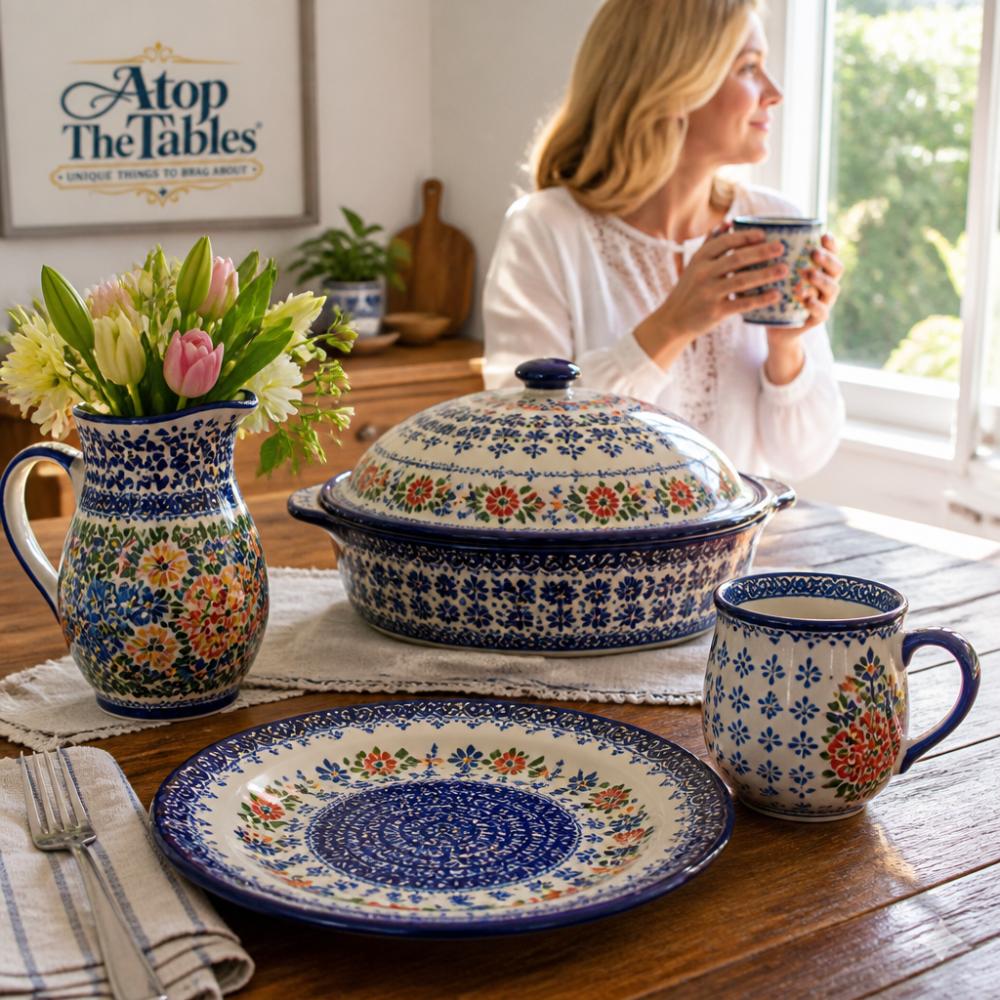
Ceramika Artystyczna Polish Pottery →
Is Polish Pottery a Good Investment?
The useful answer is that Polish pottery splits into two markets that behave nothing alike, and knowing which one you are buying into matters more than any forecast.
Two Markets, Two Behaviors
The user market is the larger one. Standard repeating patterns trade as housewares: bought to be used, they hold up for decades and resell near what a buyer would pay new. With no scarcity to bid against, there is no premium to capture.
What Actually Drives Collector Value
- Artist attribution. A hand-applied signature or initials from an established designer is the single strongest signal. Work by a named pattern designer carries a premium that an unsigned piece from the same workshop does not, even when the decoration is comparable.
- Pattern status. Retired and special-edition patterns hold interest because supply is fixed. Open-ended production patterns do not, because the workshop can always make more.
- Form and function together. A piece that is both display-worthy and genuinely useful, a large serving form, a covered baker, a statement bowl, attracts two kinds of buyers at once, which supports resale better than a purely decorative object.
- Condition. Chips, cracks, repairs, and heavy crazing cut value sharply. Unmarred glaze matters more than age; a clean recent piece will often outperform a chipped older one.
- Completeness. Original lids, matching saucers, and intact factory marks all help. A missing lid on a covered form is a permanent discount.
How to Judge a Piece Before You Buy
Turn it over first. A collector-grade piece shows a factory stamp, a pattern number, and an artist's mark, with brushwork on the base and rim underside as deliberate as the top. A partial or obscured number is common on older work and not by itself a red flag, a factory sticker can cover most digits while the artist's signature on the reverse still confirms origin.
- Is the artist named and documented? Verifiable attribution is worth more than attribution taken on faith.
- Is the pattern still in production? If it is, you are buying a user piece regardless of how it is signed.
- Would you use it if it never appreciated? If not, the piece is a speculation, not a collection.
A missing signature on a piece sold as UNIKAT is the most common red flag. If the seller cannot show you the base, ask for a photo before you buy. Reproductions almost never bother to fake the underside, because most buyers never look.
Storage and Long-Term Care
The Smithsonian's resources on preserving ceramic collections are worth reading if you plan to store pieces long term, and the U.S. Consumer Product Safety Commission guidance on household products covers general safety expectations for items used around food. For storage, the rules are simple: pad between stacked pieces, avoid attics and garages with freeze-thaw swings, and keep pieces out of direct sun, which can fade decoration over years.
The Honest Framing
I would not buy Polish pottery expecting a return. The collector market is real but thin, rewarding patience and knowledge rather than timing. What the material offers is a piece you will use daily for twenty years, and a signed piece that tends to appreciate slowly while you do. Buy the form you will reach for, buy the artist you can name, and treat any appreciation as a side effect.
Frequently Asked Questions
What is so special about Polish pottery?
Polish pottery from Boleslawiec is made from white clay and fired at high temperatures, which gives it a dense, chip-resistant body and good heat retention. Each piece is hand-decorated with sponge stamps and brushes, so no two are exactly alike. The glaze is lead-free and cadmium-free, making it safe for food contact. Pieces are also microwave safe, oven safe, dishwasher safe, and freezer safe, which is unusual for decorated stoneware.
How can you verify the authenticity of Polish pottery?
Turn the piece over. Genuine Boleslawiec stoneware carries a printed factory stamp, usually reading 'Hand made in Poland' along with the manufacturer's name. UNIKAT pieces also carry a hand-painted pattern number and often the artist's signature or initials. Look for a glossy, even glaze with no bubbles or bare patches, and check that the pattern is painted rather than a decal. A factory sticker alone is not proof, since stickers fall off with washing.
Is Polish pottery durable enough for daily kitchen use?
Yes. High-fire glazed stoneware is fired at temperatures that fuse the glaze to the clay body, producing a surface that resists chipping and staining better than low-fire earthenware. The dinner plates in the current selection weigh about 2 pounds 6 ounces each, which reflects a substantial, dense body. All listed pieces are dishwasher safe and microwave safe, and most are oven safe. Avoid sudden temperature changes, which is the main cause of cracking.
How should you care for and clean vintage Polish pottery pieces?
Wash by hand with warm water and mild dish soap for older or heavily decorated pieces, and use the dishwasher only for pieces the maker lists as dishwasher safe. Skip abrasive scouring pads and citrus-based cleaners, which dull the glaze over time. Never move a piece straight from the freezer to a hot oven. Let it come to room temperature first. Store plates with a felt pad or paper plate between them to prevent rim chipping.
Is Polish pottery worth money as a collectible?
Signed UNIKAT pieces by recognized artists hold the most collector interest. Pattern numbers, artist signatures, and dated markings all affect value. Special edition patterns, such as the 2008 'Songs from My Garden' design by Maria Starzyk, are sought after because production was limited. Standard unmarked pieces are bought mainly for daily use rather than resale. Condition matters most: chips, cracks, and repairs cut value sharply, while an intact glaze and crisp pattern keep it.
Building a collection that actually gets used takes patience, and the hardest part is knowing which pieces are authentic and which sellers will stand behind them. AtopTheTables has been sourcing from estates and auctions since 2003, with over twenty years of curation behind every listing, personally selected inventory rather than catalog-sourced stock, and careful packaging built for delicate stoneware. Explore the collection and find a piece with a story worth passing down.