
How to Identify Authentic Vintage Crystal
Table of Contents
- The Ring Test: Sound as Your First Clue
- Lead Crystal vs Glass Test: Understanding Lead Oxide Content
- Weight and Density: What Authentic Vintage Crystal Feels Like
- Refractive Index and Light Dispersion: The Prism Effect
- Identifying Crystal Patterns: Cut Glass vs Pressed Glass
- Vintage Crystal Hallmarks: Maker's Marks and Signatures
- Tactile Testing and Visual Inspection for Authenticity
- Cleaning and Maintenance: Preserving Your Authentic Pieces
- Frequently Asked Questions
Last Updated: September 25, 2026
Authentic vintage crystal tells a story through sound, weight, and light. At AtopTheTables, we've spent over two decades sourcing genuine pieces from estates and auctions, learning to distinguish real crystal from clever reproductions. This guide shows you exactly how to identify authentic vintage crystal using tests you can perform at home.
The Ring Test: Sound as Your First Clue
The ring test is your quickest authentication tool. Hold the piece gently and tap it lightly with your fingernail or a soft object. Authentic crystal produces a clear, bell-like chime that resonates for several seconds. Regular glass makes a dull thud and stops quickly.
Crystal's higher lead oxide content creates denser material that vibrates differently, producing sustained resonance that glass cannot replicate.
A true musical resonance indicates quality crystal; flat or muted sound suggests pressed glass or imitation.
Lead Crystal vs Glass Test: Understanding Lead Oxide Content
Lead crystal contains lead oxide, which fundamentally changes how glass behaves. Crystal with 24% lead oxide (common in vintage European pieces) feels substantially heavier than ordinary glass, one of your most reliable indicators.
Pick up the piece. Real crystal feels denser and more substantial in your hand. The weight should feel intentional and solid. Glass pieces of similar dimensions feel noticeably lighter by comparison.
Lead oxide also affects clarity. Authentic crystal appears luminous when held to light, transmitting light with exceptional purity; ordinary glass looks cloudier by comparison.
Verifying Lead Content Through Maker's Documentation
Check the base and edges for markings indicating lead content. Many vintage European makers stamped "24% Lead Crystal" or "Full Lead Crystal" directly on the piece.

If no marking is visible, research the manufacturer and production era. Most reputable vintage crystal makers from the 1920s-1980s documented their lead content in catalogs or product literature. A piece from a known lead-crystal manufacturer during this period is far more likely to contain lead than one from an unknown maker or produced after 2000.
Modern Reproductions vs. Authentic Vintage Lead Crystal
Modern "vintage-style" crystal is often lead-free by design, as manufacturers shifted away from lead in the 1990s. These reproductions can mimic appearance but lack the weight, refractive properties, and sound of authentic lead crystal.
To distinguish authentic vintage from modern reproduction:
- Weight test: Authentic 24% lead crystal pieces are noticeably heavier. If a piece feels light and airy despite its size, it's likely modern lead-free glass.
- Ring test consistency: Authentic lead crystal produces a sustained, musical tone. Modern lead-free reproductions produce a shorter, flatter tone because the material doesn't vibrate with the same resonance.
- Refractive brilliance: Authentic lead crystal shows dramatic prismatic effects and "fire" (rainbow dispersion) even in diffused light. Lead-free glass shows less intense color separation and appears duller overall.
- Production era: Pieces marked "Made in [country]" with a date code or patent number from before 1995 are far more likely to contain lead. Pieces with no date marking or vague "vintage-inspired" labeling are often modern reproductions.
Weight and Density: What Authentic Vintage Crystal Feels Like
Hold two pieces side by side. Authentic vintage crystal feels noticeably heavier than modern glass or reproductions of similar size. Vintage manufacturers used substantial glass walls; modern alternatives use thinner walls to reduce costs. The difference is obvious in direct comparison.
Genuine pieces from the American Brilliant period (1876-1917) or European crystal houses typically weigh significantly more than contemporary reproductions.

Press the piece against a scale if you have access to one. Lightweight pieces are usually glass, not crystal.
Refractive Index and Light Dispersion: The Prism Effect
Authentic crystal bends light differently than ordinary glass. Hold the piece to natural light and observe spectral colors and prism effects. Lead oxide increases the refractive index, causing light to bend sharply and separate into component colors, most visible in cut or faceted pieces.
Look for brilliance, intense sparkle from cut surfaces. Authentic vintage crystal exhibits exceptional brilliance due to its composition and skilled craftsmanship; mass-produced glass cannot achieve the same light refraction.
American Brilliant Cut Crystal Pedestal →
Examine the piece from multiple angles in different lighting conditions. Move it slowly and watch how light behaves. Genuine crystal shows consistent, dramatic light play. Reproductions appear duller or show less dramatic color separation.
Identifying Crystal Patterns: Cut Glass vs Pressed Glass
Cut glass and pressed glass look similar but differ in production. Cut glass is carved after formation; pressed glass is molded during production.

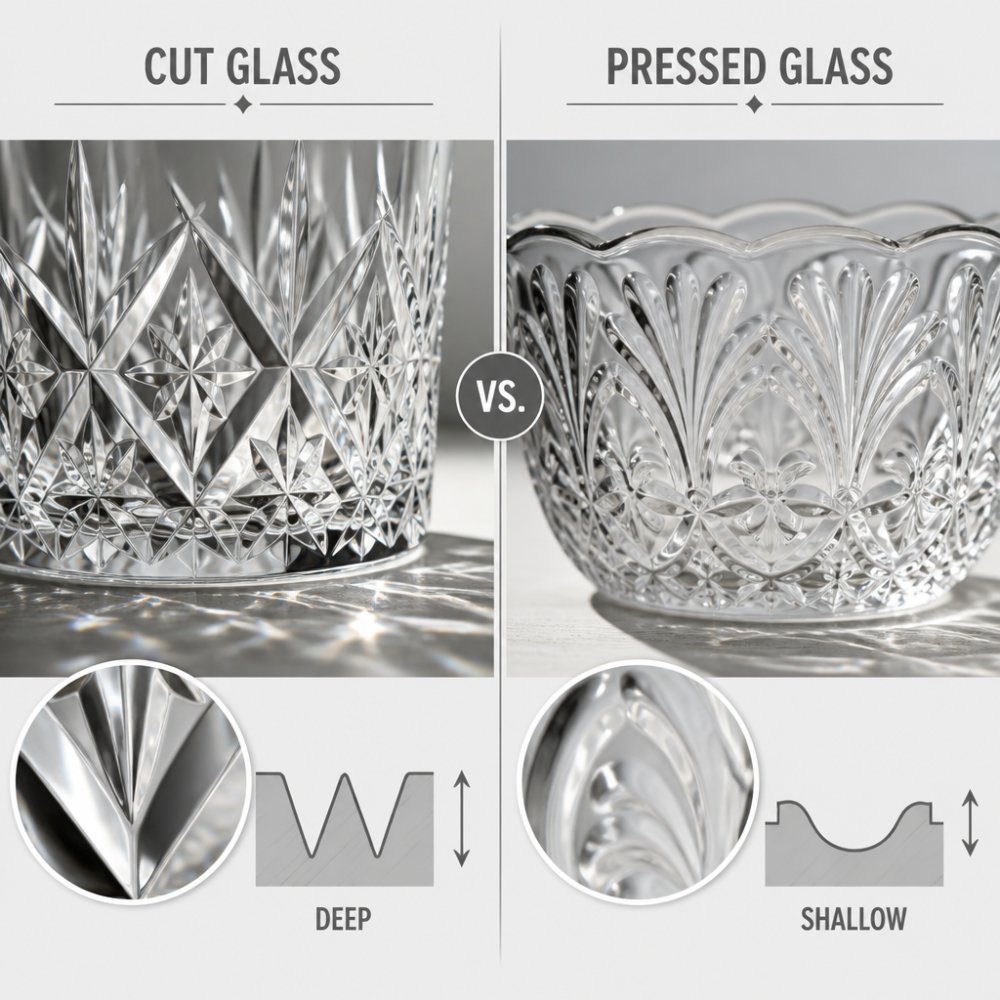
Run your finger across the pattern. Cut glass feels sharp and crisp with clean edges; pressed glass feels smoother. Cut glass shows deep, dramatic cuts creating shadows; pressed glass patterns are shallower and more uniform.
Examine pattern edges under magnification. Cut glass shows clean, sharp lines; pressed glass shows slightly rounded or blurred edges from the mold.
Vintage Crystal Hallmarks: Maker's Marks and Signatures
Authentic vintage crystal often carries a maker's mark or signature on the base, stem, or etched surface. European crystal houses frequently marked their pieces; American Brilliant makers sometimes included marks as part of the design.
Common marks include:
- Etched or embossed company names
- Country of origin stamps ("Made in France," "Germany," etc.)
- Pattern names or numbers
- Artist signatures on high-end pieces
Tactile Testing and Visual Inspection for Authenticity
Run your fingers across the entire surface. Authentic vintage crystal feels smooth and refined, free of rough spots on exposed areas. The base may show age and patina but should not feel rough or poorly finished.
Cleaning and Maintenance: Preserving Your Authentic Pieces
Proper care preserves the brilliance and integrity of authentic vintage crystal. Understanding how to safely restore and maintain them is essential for collectors.
Basic Cleaning for Display Pieces
Clean gently using warm water and mild dish soap. Avoid harsh chemicals or abrasive scrubbers that can damage the surface or strip any patina that adds to the piece's authenticity.
Removing Cloudiness and Mineral Deposits
Vintage crystal often develops a cloudy or frosted appearance from mineral deposits, hard water residue, or age-related surface changes. This is one of the most common restoration challenges.
Addressing Chips, Cracks, and Surface Damage
Small chips on rims or edges are common in vintage crystal and do not necessarily reduce authenticity, they're evidence of age and use. However, they can be sharp and may worsen over time.
Storage and Display Best Practices
For decorative pieces displayed in cabinets, dust occasionally with a soft cloth. Avoid moving pieces unnecessarily; each handling increases the risk of breakage. Store pieces in stable positions where they won't tip or slide.
Frequently Asked Questions
How do I tell the difference between authentic crystal and regular glass?
Authentic vintage crystal contains lead oxide, which makes it heavier, denser, and more brilliant than standard glass. Use the ring test: gently tap the piece with your finger or a soft object. Crystal produces a clear, bell-like chime that resonates, while glass makes a dull thud. Check the weight, crystal feels substantially heavier for its size. Look for exceptional light refraction and sparkle. Most vintage crystal pieces have maker's marks or signatures on the base. If you're evaluating a piece from AtopTheTables, the condition report and sourcing details provide authentication verification.
What should I look for when identifying crystal patterns on vintage pieces?
Examine whether the pattern is cut or pressed. Authentic cut crystal has sharp, deeply incised geometric lines with crisp edges, hobstars, diamonds, and crosshatching are hallmarks of American Brilliant Cut Glass (1876-1917). Pressed glass has shallower, molded patterns with softer edges. Run your finger gently across the pattern: cut crystal feels sharp and defined, while pressed glass feels smoother. Look for mold lines on pressed pieces. Handcrafted crystal often shows slight irregularities and pontil marks (small indentations on the base where the piece was held during production). These variations indicate authentic vintage craftsmanship, not mass production.
What do vintage crystal hallmarks and maker's marks tell me?
Maker's marks, signatures, and hallmarks are critical authentication tools. Look on the base or bottom of the piece for etched, embossed, or acid-stamped marks. French crystal often bears 'FRANCE' or maker names like J.G. Durand or Baccarat. German makers like Mikasa stamped their lead crystal content (e.g., '24% Lead Crystal'). American Brilliant Cut Glass rarely has maker's marks, but the pattern style and weight identify it. Pontil marks, small rough spots where the glassmaker's tool held the piece, indicate hand-blown or hand-finished pieces. Research the mark or signature to verify the maker, origin, and approximate production period. Authentic vintage pieces from reputable dealers like AtopTheTables include documented sourcing and condition reports that confirm these details.
Is vintage crystal safe to use for eating and drinking?
Authentic vintage lead crystal is safe for display and occasional use, but the FDA advises caution with high-lead-content pieces for regular drinking or food storage. Lead oxide in crystal can leach into acidic beverages (wine, citrus juice, vinegar) or foods stored long-term. Display pieces and decorative items like compotes and paperweights pose no risk. For serving, use lead-free crystal or reserve high-lead pieces for special occasions with minimal contact time. Always hand-wash vintage crystal, dishwashers can damage delicate patterns and accelerate any potential leaching. Never microwave. Most vintage crystal from reputable sources like AtopTheTables is documented for lead percentage and condition, helping you make informed decisions about display versus use.