
Why Crystal Glass Gets Cloudy Over Time: Causes and Fixes
Table of Contents
- Etching vs. Mineral Deposits: Two Kinds of Cloudy Crystal
- What Hard Water Leaves Behind
- What Etching Actually Removes
- How to Test Whether Your Crystal Is Etched or Just Dirty
- How to Remove Cloudiness From Crystal Without Causing Damage
- Preventing Glass Etching on Vintage Crystal
- Water Hardness, Detergent, and Rinse Aid: What Actually Drives the Haze
- Restoration vs. Replacement: Deciding What to Do Next
- Frequently Asked Questions
Last Updated: September 28, 2026
Etching vs. Mineral Deposits: Two Kinds of Cloudy Crystal
Cloudy crystal is one of the most common heartbreaks in collecting, and most owners misdiagnose it. The haze is usually one of two things: a mineral film sitting on top of the surface, or permanent etching that has eaten into it. One you can fix. The other you cannot.
At AtopTheTables, operating since 2003, the question often arises: why does crystal glass get cloudy over time? The answer almost always traces back to the dishwasher, hard water, or both.
Mineral deposits are a film of dissolved solids left behind when water evaporates. They sit on the surface and respond well to gentle acid.
Etching is permanent corrosion of the glass itself, caused by harsh detergent and heat. No polish brings it back.
What Hard Water Leaves Behind
Hard water carries dissolved calcium and magnesium. When water evaporates off your crystal, those minerals stay behind as a chalky film, mainly calcium carbonate, magnesium hydroxide, and calcium sulfate, building up in thin layers over many wash cycles.
A few things make it worse:
- Letting crystal air-dry instead of towel-drying
- Skipping the rinse aid
- Washing in water above 140°F
- Using too much detergent for a light load
The good news: mineral film sits on top of the glass. It has not damaged anything yet.
What Etching Actually Removes
Etching is not a coating. It is the glass surface being dissolved away, atom by atom, and the chemistry explains why some pieces haze and others survive decades of the same treatment.
Glass is a silica network, silicon dioxide (SiO2) linked into a rigid, repeating lattice. In pure form it resists water and mild chemicals, but its silicon-oxygen bonds are vulnerable to hydroxide ions (OH-).
Dishwasher detergent is strongly alkaline, producing a high concentration of hydroxide ions. Those ions break the silicon-oxygen bonds at the glass surface, converting surface silica into soluble silicates that rinse away, leaving a microscopically pitted surface. Light scatters off those pits instead of passing through cleanly, and that scattered light is the dull, frosted haze you see.
This is why etching is irreversible: you are not removing a film, you are removing glass. No polish, soak, or cloth can put the dissolved silica back.
Here is the part most guides miss: it is not just the detergent, but three things working together:
- Alkalinity from the detergent, which supplies the hydroxide ions
- Heat, which speeds up the reaction rate, roughly doubling it for every 18°F (10°C) rise in water temperature
- Time, because the reaction is cumulative and each wash cycle removes another microscopic layer
Remove any one of the three and the damage slows dramatically. Remove all three, hand wash in warm, not hot, water with a pH-neutral soap, and it effectively stops.
Lead crystal is especially vulnerable, and the reason is counterintuitive. The lead oxide (typically 24% to 32% by weight in fine lead crystal) that gives the glass its brilliance and soft ring is not fully locked into the silica network, leaving the surface softer and more chemically reactive. The same property that makes lead crystal beautiful makes it easier to etch.
Modern lead-free crystal substitutes barium oxide or zinc oxide for the lead, producing similar brilliance with a somewhat more durable surface, though the difference is modest and does not make them dishwasher-safe long term.
How to Test Whether Your Crystal Is Etched or Just Dirty
You can tell the difference in about 60 seconds with your eyes and a little vinegar.
American Brilliant Cut Crystal Pedestal →
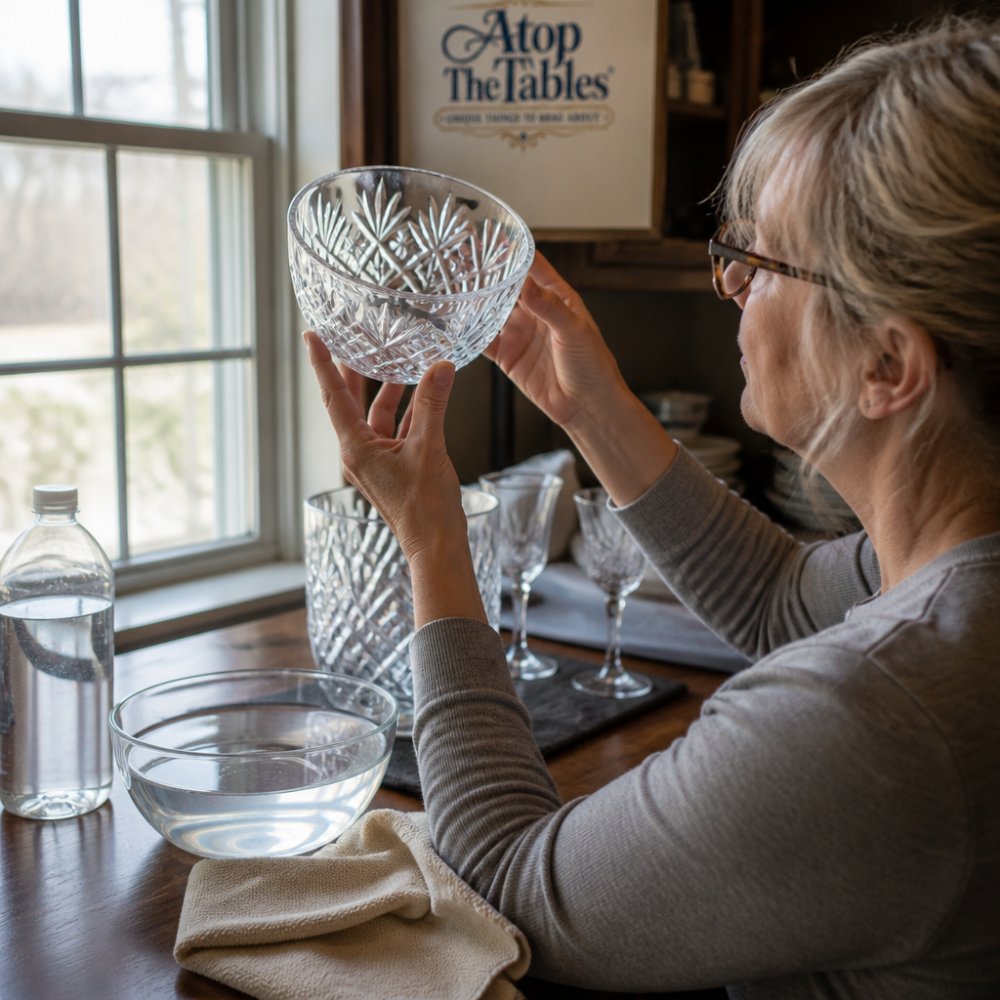
Try these three checks:
- The light test. Hold the piece up to a bright window. Mineral film looks like a uniform milky coating; etching looks like a dull, frosted patch, often in a ring or band.
- The vinegar test. Soak a small area in white vinegar for 10 minutes. If the haze lifts, it was mineral. If nothing changes, it is etched.
- The feel test. Run a fingernail across the cloudy area. Etched glass feels slightly rough or chalky; mineral film feels smooth under a thin layer.
- The water spot test. White spots that follow a drip pattern are mineral. A uniform dullness with no pattern points to etching.
How to Remove Cloudiness From Crystal Without Causing Damage
Mineral film comes off with acid and patience. Dissolve the deposits, do not scrub them.
A Vinegar Soak That Lifts Mineral Film
Mix one part white vinegar with three parts warm water in a plastic basin and let the crystal sit for 15 to 30 minutes.
When to Stop and Accept Permanent Damage
If the vinegar soak leaves the haze untouched, the glass is etched. Stop.
Preventing Glass Etching on Vintage Crystal
Prevention is the only real fix, and it costs nothing but a few changed habits.
Hand Washing, Drying, and Storage Habits That Matter
Wash crystal by hand in warm water with a mild, pH-neutral soap. Use a soft sponge, never a scouring pad.
A quick comparison of what each habit protects against:
| Habit | What It Prevents | Effort |
|---|---|---|
| Hand wash with mild soap | Etching from alkaline detergent | 5 min per load |
| Towel-dry immediately | Mineral spots and film | 1 min per piece |
| Use distilled water | New mineral deposits | Minimal |
| Store with space between pieces | Chips and micro-abrasions | One-time setup |
| Skip the dishwasher entirely | Permanent surface degradation | None |
Water Hardness, Detergent, and Rinse Aid: What Actually Drives the Haze
Three factors decide whether your crystal hazes: water hardness, detergent type, and rinse aid. The useful part is understanding how each works and where the trade-offs sit.
Water Hardness and What the Numbers Mean
Water hardness is the concentration of dissolved calcium and magnesium in your tap water, usually reported in milligrams per liter (mg/L) or grains per gallon (gpg). The U.S. Geological Survey classifies water as soft below 60 mg/L, moderately hard from 60 to 120 mg/L, hard from 120 to 180 mg/L, and very hard above 180 mg/L (Hardness of Water). Roughly, 1 gpg equals about 17.1 mg/L.
Detergent Chemistry: Why Powder Is Worse Than Gel
Detergent type matters as much as water. The key variable is pH, which measures alkalinity on a 0 to 14 scale. The higher the pH, the more hydroxide ions are available to attack glass.
- Powdered dishwasher detergents tend to run the most alkaline, often in the pH 10 to 12 range, because the builders and bleach activators that make them effective on food residue also raise pH.
- Gel detergents are typically less alkaline, though still well above neutral.
- Pod and tablet detergents vary widely by formulation and often combine high alkalinity with enzymes and oxygen bleach.
- Mild hand-dish soaps formulated as pH-neutral sit near 7, which is why they are the safe choice for crystal.
Rinse Aid: What It Does and Does Not Do
Rinse aid is a surfactant that lowers the surface tension of water so it sheets off glass instead of forming droplets. Fewer droplets means fewer spots, because less water is left to evaporate and leave minerals behind.
Restoration vs. Replacement: Deciding What to Do Next
Some cloudy crystal can be saved. Some cannot. Here is how to decide.
| Situation | Best Move | Why |
|---|---|---|
| Haze lifts with vinegar | Keep and hand wash going forward | It was mineral film |
| Haze stays after vinegar soak | Display or repurpose | Surface is etched |
| Light etching on a display piece | Keep for decor | Haze reads as patina |
| Heavy etching on a daily-use piece | Replace | Function and looks are gone |
| Sentimental or rare piece | Consult a professional glass restorer | Some polishing is possible |
Frequently Asked Questions
Is cloudy crystal glass permanent?
Sometimes, but not always. If the haze is mineral deposits from hard water, a vinegar soak or hand wash with mild detergent can usually clear it. If the surface feels rough or the cloudiness stays after cleaning, the crystal is likely etched. Etching removes the top layer of glass, so it cannot be reversed. A piece like the Marquis by Waterford etched crystal vase, kept out of the dishwasher, holds its clarity far longer.
What causes etching in crystal glassware?
Etching happens when alkaline dishwasher detergent and hot water pull minerals out of the glass surface over many cycles. Lead crystal is especially vulnerable because its structure is softer than everyday glass. The result is a permanent hazy film, not a coating you can scrub off. Hand washing with a mild soap and drying right away is the simplest way to avoid it.
Can you fix cloudy crystal caused by hard water?
Yes, in most cases. Hard water leaves calcium carbonate and magnesium hydroxide on the surface. Soak the piece in a mix of one part white vinegar to three parts warm water for 20 to 30 minutes, then rinse and dry with a lint-free cloth. Skip abrasive pads, which scratch the surface and trap more residue. If the cloudiness remains after two soaks, the issue is etching, not buildup.
Does dishwasher use ruin crystal glass?
It can, and the damage builds up quietly. Most crystal is not dishwasher safe. Hot water, alkaline detergent, and long wash cycles combine to etch the surface and dull the sparkle. If you must use a dishwasher, choose a gentle cycle with no heated dry and a phosphate-free detergent, but hand washing remains the safer habit for vintage pieces.