
Choosing a Ceramic Teapot for Your Collection
Last Updated: November 7, 2026
Quick Summary
The right ceramic teapot depends on its purpose. Decide first whether it is for daily brewing or display, then check its interior glaze, capacity and pour. Porcelain, earthenware and stoneware each brew differently, so choose the body that suits how you drink tea.
- Functional pieces should pour cleanly, sit steady, and hold a comfortable amount of tea.
- Inspect the interior for an even, continuous glaze with no bare clay patches.
- Ask the maker for documentation confirming a food-safe, lead-free glaze.
- Usable capacity is lower than listed capacity, so a 32-ounce pot may pour three cups.
- Always test the pour and handle with the pot filled to a realistic level.
Table of Contents
- Start With Your Collection's Purpose
- Porcelain vs. Ceramic Teapot: What Changes for a Collector
- Ceramic Teapot Size Guide and Shape Choices
- Caring for and Storing Your Vintage Ceramic Teapot
- Frequently Asked Questions
Start With Your Collection's Purpose
Before you buy any ceramic teapot, decide what it is for. A brewing pot needs a different shape and finish than a display piece, and a clear purpose prevents regret purchases.
- Will you use it? Functional pieces should pour cleanly, sit steady, and hold a comfortable amount of tea.
- Are you displaying it? Decorative pieces can have bold glazes, figural shapes, or unusual handles.
- Is it part of a set? Matching pieces look best when they share a color or pattern.
Porcelain vs. Ceramic Teapot: What Changes for a Collector
Porcelain and the broader ceramic family, earthenware and stoneware, differ in clay body, firing temperature, wall thickness, and porosity, which changes both brewing and evaluation. To see a real example, browse this vintage Belleek porcelain creamer.

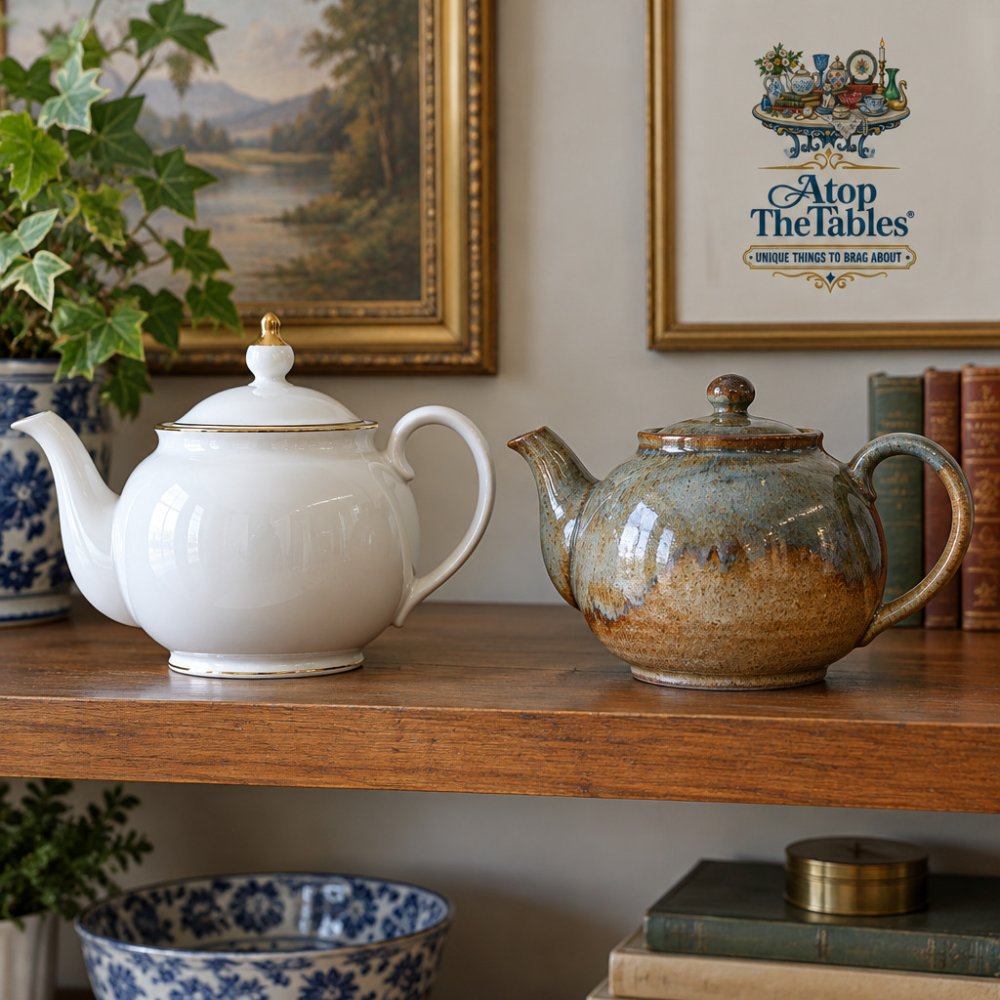
Porcelain is a fine, dense clay fired at high temperature. The body vitrifies, so it is nonporous even before glazing, which is why porcelain is usually thin, light, translucent, and white.
Earthenware is fired at a lower temperature than porcelain. The body stays porous, so it must be glazed to hold liquid. It is thicker, warmer to the touch, and often more richly colored. For a signed example, view this vintage hand-thrown Mexican pottery teapot.

Stoneware sits between the two: dense and durable, but usually thicker and more textured than porcelain. It is the most common body for everyday ceramic teapots.
Why the Interior Glaze Matters More Than the Outside
A teapot's exterior glaze is decorative; the interior glaze is functional. A fully glazed interior is nonporous, does not retain flavors between teas, and is easy to clean. An unglazed interior is porous: it seasons over time, which some tea drinkers value and others find holds onto strong flavors.
Look inside the pot with a flashlight. You want an even, continuous glaze with no bare clay patches unless the maker intended an unglazed interior.
Food-Safe Glazes and What to Check
Glaze chemistry is the part of ceramic buying most collectors overlook. Lead and cadmium were once common in decorative glazes, and older or imported pieces may not meet current food-contact expectations (the FDA). In the United States, food-contact ceramics are addressed by FDA regulations. Check with the maker about how their glazes are tested.
- Ask for documentation. Reputable makers can usually confirm a food-safe, lead-free glaze. If a seller cannot, treat the piece as decorative.
- Inspect for crazing. A fine network of cracks in the glaze is not always a defect, but it can let liquid reach the porous body beneath.
- Check for worn or chipped glaze, especially around the rim and spout.
- Be cautious with heavily decorated interiors, metallic lusters and bright overglaze enamels inside the pot are a reason to ask questions.
A beautiful exterior glaze tells you nothing about the interior, so always inspect the inside before committing a pot to daily use.
How Construction Affects Brewing
Thick-walled stoneware and earthenware generally hold heat longer, while thin porcelain sheds heat more quickly. A porous unglazed interior can mute flavors over time; a nonporous glazed interior keeps each tea tasting like itself.
Both families are worth owning. Judge each piece on its own terms.
Ceramic Teapot Size Guide and Shape Choices
Size and shape are where a teapot stops being an object and becomes a tool. Match capacity to your brewing habit, then test the pot's handling before you commit.
Matching Capacity to Serving Size
- 12-20 ounces: one to two cups. Good for solo brewing or gongfu-style sessions where you pour small infusions repeatedly.
- 24-32 ounces: two to four cups. The most versatile range for daily use.
- 36-48 ounces: four to six cups. Suited to households or entertaining, but heavier when full.
Usable capacity is lower than listed capacity, leaves and an infuser basket take up volume. A 32-ounce pot may realistically pour three cups, not four. To see a complete teapot, creamer and sugar set and judge proportions, view this matching blue set with trivet.

Reading Shape for Handling
Shape determines balance, and balance determines whether you reach for the pot or leave it on the shelf.
- Rounded, low bodies sit stable and keep the center of gravity low when full.
- Tall, narrow bodies raise the center of gravity; a full tall pot is more likely to tip if the handle is offset.
- Wide, shallow bodies expose more leaf to water and suit teas that need room to unfurl.
- Offset or side handles change the pour mechanics, test them with a full pot, not an empty one.
A Repeatable Pour and Usability Test
- Fill it with water to a realistic level and pour slowly, then quickly.
- Watch the spout. A well-cut spout delivers a clean stream and stops without dribbling. A spout that drips will stain the body over time.
- Check the lid. Tip the pot toward the pour and confirm the lid stays seated; a loose lid is a scald risk.
- Test the handle. Grip it as you would when full, it should clear your knuckles and feel balanced.
- Check strainer fit. Confirm an infuser basket or built-in strainer seats securely and leaves room for leaf expansion.
- Look at the base. A flat, wide foot resists tipping; a narrow foot on a tall body is a warning sign.
A pot that pours perfectly when half full can behave very differently when full, so always test at realistic capacity.
Shape as a Collection Criterion
For display, shape is a design decision, figural pots, novelty handles, and sculptural bodies are collected for their form. For use, shape is functional. Separate the two: buy display pieces for silhouette and glaze, and brewing pieces for pour quality, lid security, and balance.
The main capacity ranges and what each suits, as covered in this section:
| Capacity | Serves | Best for |
|---|---|---|
| 12-20 ounces | One to two cups | Solo brewing or gongfu-style sessions |
| 24-32 ounces | Two to four cups | Most versatile range for daily use |
| 36-48 ounces | Four to six cups | Households or entertaining; heavier when full |
Usable pour capacity by teapot size
Caring for and Storing Your Vintage Ceramic Teapot
Vintage ceramics need gentle care. Wash by hand in warm water with mild soap, and avoid sudden temperature changes. For a sense of how sturdy vintage stoneware can be, see this oven-proof brown stoneware pitcher.
For storage, wrap each teapot in acid-free tissue and keep lids separate or loosely placed so they do not chip the rim. Store in a dry place away from direct sun.
Our pick for a collector is the Vintage Ken Edwards Tonala Mexico Pottery Teapot, priced at $44.77. It is signed and includes a removable lid. Browse the full selection at explore our teapot collection and find the piece that fits your collection.
Frequently Asked Questions
What is the best ceramic teapot?
The best ceramic teapot depends on how you plan to use it. For a display collection, choose a piece with an intact glaze, a clear maker's mark, and a shape you find appealing. For brewing, look for a sound lid that sits firmly, a spout that pours without dripping, and a body size that matches how many cups you usually serve. Pieces listed with no chips, cracks, or crazing are the safest starting point, and an item such as the Vintage Ken Edwards Tonala Mexico Pottery Teapot, listed at $44.77 with no apparent damage, is one example to review.
Which is better, porcelain or ceramic teapot?
Neither is better across the board. Porcelain is fired at higher temperatures and is generally denser and whiter. Ceramic, including earthenware and stoneware, is often heavier and generally holds heat longer. For a collection, choose on appearance and condition, not material alone. Check the base of any piece for the maker's mark and the country of origin, since both help you judge age and authenticity.
How should you care for a vintage ceramic teapot?
Hand wash vintage ceramic teapots in warm water with mild soap, and avoid abrupt temperature changes that can cause crazing or cracks. Dry it fully before storing, store the lid separately or wrapped with soft cloth, and avoid stacking heavy items on top. Handle the spout and handle gently.

