
7 Steps to Choose UNIKAT Polish Pottery Serving Trays
Last Updated: October 25, 2026
Quick Summary
To choose UNIKAT Polish pottery serving trays, start with size and shape: pick a medium 12-13 inch oval or scalloped oval for your first tray, then match the pattern to your table. Confirm authenticity by checking the base stamp, a U pattern number, and smooth first-quality glaze.
- UNIKAT means unique in Polish and marks the highest decoration tier, with designs that vary piece to piece.
- Small trays run roughly 8 to 10 inches, medium 11 to 13 inches, and large 14 inches and up.
- A 12.5-inch oval tray is the workhorse size for four to eight guests.
- Pick one anchor pattern, note its two or three colors, and add only pieces repeating those colors.
- Genuine pieces carry a base stamp with Hand made in Poland and the workshop name.
Table of Contents
- What UNIKAT Polish Pottery Meaning Tells You Before You Buy
- Polish Pottery Serving Tray Sizes: Match the Tray to the Occasion
- Polish Pottery Serving Platter Shapes and What Each One Does Best
- UNIKAT Polish Pottery Patterns: Coordinating a Collection That Works Together
- How to Identify Authentic UNIKAT Pottery and First-Quality Pieces
- Care, Durability, and Safe Use for Daily Entertaining
- Shop UNIKAT Serving Trays at AtopTheTables
- Frequently Asked Questions
What UNIKAT Polish Pottery Meaning Tells You Before You Buy
UNIKAT Polish pottery means a piece was decorated by hand as a one-of-a-kind design, not stamped out in a repeating factory line (126 Years of Tradition).
At AtopTheTables, we have spent years handling Boleslawiec stoneware, and we can tell you the label matters more than most shoppers realize.
Here is the short version:
- UNIKAT means "unique" in Polish, and it marks the highest decoration tier.
- Standard patterns repeat exactly; UNIKAT designs vary from piece to piece.
- Each UNIKAT tray is signed with a pattern number and often an artist's mark.
That difference drives everything else: the price, the collectibility, and how you build a set that looks intentional rather than accidental.
Polish Pottery Serving Tray Sizes: Match the Tray to the Occasion
Size is the first decision, and it is the one most buyers get wrong. A tray that is too small looks crowded. One that is too large swallows the table. The fix is to work backward from the occasion and the food, not from the tray's listed length.
Start with the occasion, then the food, then the size
A simple sequence keeps you from buying a tray that only works once:
- Name the occasion. Weeknight snack, dinner-party appetizers, holiday buffet, or a centerpiece that stays out.
- Name the food and how many pieces it needs to hold. A cheese spread for six is a different footprint than olives for two.
- Pick the size band that fits that food count. The bands below are practical ranges, not exact rules.
- Check the rim depth. Depth decides whether small items stay put.
- Confirm the footprint against your table and cabinet. A tray that does not fit the shelf or the table will not get used.
Size bands and what each one actually holds
Most UNIKAT serving trays fall into three practical bands:
- Small, roughly 8 to 10 inches: dips, olives, nuts, a single cheese wedge, a handful of crackers. Best for two to four people grazing.
- Medium, roughly 11 to 13 inches: appetizers, pastries, crudités, sliced bread, a small cheese selection. The most flexible band for four to eight guests.
- Large, 14 inches and up: a full cheese spread, a party platter, a centerpiece. Built for buffets and eight-plus guests.
A 12.5-inch oval tray is the workhorse size. It holds a generous round of appetizers without dominating a table for four. If you entertain often, buy one medium tray before anything else.
Dimensions by serving occasion
Use these as starting points, then adjust for how densely you like to plate:
Occasion |
Guests |
Suggested tray size |
Why |
|---|---|---|---|
Snacks for two |
2 |
8-10 in |
Small footprint, no wasted space |
Weeknight appetizers |
4 |
11-12 in |
Holds a few items without crowding |
Dinner-party starters |
6-8 |
12.5-13 in |
The workhorse band |
Holiday buffet |
8+ |
14 in+ |
Room for a full spread and refills |
Centerpiece |
Any |
12.5 in+ |
Reads as a focal point, not a side dish |
Capacity matters as much as length
A shallow tray with a 1.5-inch rim keeps olives and nuts contained. A flatter platter suits cheese and sliced fruit. Check the depth before you commit, and think about how the food will sit: a tray with a raised rim holds loose items; a flat platter lets you slide a knife under a wedge of cheese.
A quick capacity check: a medium tray should hold a small cheese selection plus crackers without items touching the rim. If you find yourself piling food above the rim, you need the next size up.
The first-tray rule
If you are buying your first UNIKAT serving tray, choose one medium oval or scalloped oval in the 12-13 inch range. It covers the most occasions, stores easily, and gives you a reference point for every tray you add later.
Polish Pottery Serving Platter Shapes and What Each One Does Best
Shape decides how a tray performs at the table. The five common forms each solve a different problem.
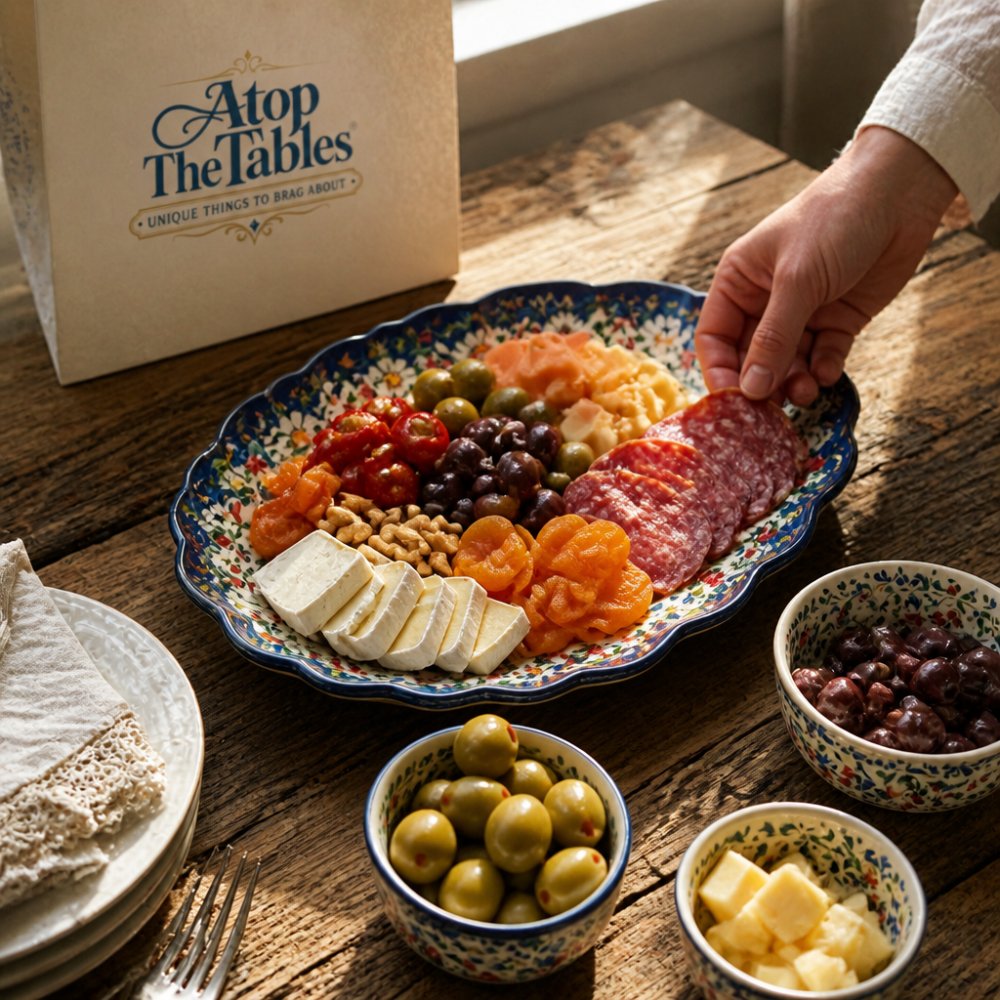
- Oval platter: the best all-rounder for cheese, sliced meats, and pastries. The long shape fits a crowded table.
- Scalloped oval tray: same footprint, but the wavy rim adds visual interest and helps contain small items. Our Hummingbird Meadow scalloped oval tray shows how much a flowing edge changes the look.
- Round tray: ideal for a cheese board or a single large item. Round trays read as centerpieces.
For a first purchase, an oval or scalloped oval covers the most occasions. A rectangular serving tray is worth adding if you plate sandwiches or sliced cake, since straight edges line up neatly with food.
UNIKAT Polish Pottery Patterns: Coordinating a Collection That Works Together
Pattern coordination is where a collection either comes together or falls apart. The rule we follow: pick one dominant pattern, then choose supporting pieces that share a color family rather than a motif. That single rule prevents the most common mistake, buying trays one at a time because each one is beautiful on its own, then finding they fight on the table.
A step-by-step collection plan
- Choose your anchor piece first. Pick the tray or platter you will use most often and treat its pattern as the anchor. Everything else coordinates to it.
- Pull the anchor's two or three dominant colors. Write them down. These are the only colors your supporting pieces need to share.
- Decide your ratio. A common pattern is one anchor pattern plus one or two supporting patterns, used at roughly 70/30 across the table. Too many patterns at equal weight reads as clutter.
- Add one neutral or geometric piece. A cobalt-and-white geometric tray or bowl calms a busy floral table and gives the eye a rest.
- Buy the next size you actually lack. Coordinate by function first, pattern second, a collection that covers small, medium, and large occasions is more useful than three trays in the same size.
Pattern families and how they pair
UNIKAT patterns tend to fall into a few families:
- Floral: meadows, blossoms, garden scenes. Teresa Liana's Hummingbird Meadow and Splendid Meadow sit here. Floral patterns pair well with geometric and folk pieces that repeat one of their colors.
- Geometric: balanced repeating elements, often in cobalt and white. The safest supporting pattern because it rarely competes for attention.
- Folk and lace: fine linework inspired by traditional Boleslawiec decoration. Works best as a supporting piece next to a larger floral anchor.
Cobalt blue, greens, browns, reds, and yellows recur across makers, so a red floral tray and a cobalt geometric bowl can sit on the same table without clashing. The trick is to repeat one or two colors, not every color.
Ceramika Artystyczna UNIKAT Hummingbird Meadow Scalloped Oval Tray 12.5" →
Mixing UNIKAT with standard patterns
UNIKAT pieces can share a table with standard repeating patterns, but the balance matters. Treat the UNIKAT piece as the focal point and let standard patterns do the supporting work. If two UNIKAT pieces sit side by side, make sure they share at least one color and differ in scale, a large-scale floral next to a fine folk pattern reads as intentional; two same-scale florals read as a near-miss.
How to judge a pattern before you commit
A signed piece helps you judge how a pattern pairs in person. Our Sweet Nectar serving tray shows a specific UNIKAT design you can compare against your existing pieces before you commit. When you shop, hold the candidate next to a photo of your anchor piece and check three things: shared color, contrasting scale, and whether the motifs compete or complement.
Planning for the table you actually set
Think about how the pieces will appear together, not separately. A tray, a serving bowl, and a small dish in three patterns can work if they share a color and vary in scale. They will not work if each is a different color story. Before you add a piece, picture it on the table next to what you already own, if you cannot picture it, it is not the right addition yet.
How to Identify Authentic UNIKAT Pottery and First-Quality Pieces
Authenticity comes down to markings, finish, and the story behind the seller.
Check these markers:
- Base stamp: maker name plus country of origin, applied cleanly under the glaze.
- Pattern number: UNIKAT pieces carry a "U" number, often with the artist's signature.
- Glaze quality: smooth, even, and free of grit or bubbles on first-quality pieces.
First quality means the piece passed the workshop's inspection. Seconds may show glaze flaws or uneven decoration, and sellers should say so plainly.
Watch out: reproductions often copy the look but skip the base stamp or print it faintly. You can also examine a signed UNIKAT basket to see what genuine markings look like up close.
Care, Durability, and Safe Use for Daily Entertaining
UNIKAT stoneware is built for real use, not shelf display. The glazed surface resists scratches and chips, and most pieces are dishwasher safe.
Care basics:
- Dishwasher: safe for most UNIKAT trays. Load them so pieces do not knock together.
- Oven and microwave: many pieces handle both, but confirm per item before use.
- Freezer: safe for storing, though avoid sudden temperature swings.
A common mistake is treating a serving tray like fine china and never using it. These pieces are made to be passed around a table.
Tray Type |
Best For |
Typical Size |
Care |
|---|---|---|---|
Small oval |
Dips, olives, nuts |
8-10 in |
Dishwasher safe |
Medium scalloped oval |
Appetizers, pastries |
12.5 in |
Dishwasher safe |
Large oval platter |
Cheese, sliced meats |
14 in+ |
Dishwasher safe |
Divided tray |
Grazing boards |
Varies |
Dishwasher safe |
Corn tray |
Corn, bread, rolls |
Varies |
Dishwasher safe |
Shop UNIKAT Serving Trays at AtopTheTables
Choosing a tray comes down to four checks: right size, right shape, a pattern that fits your table, and markings that prove it is genuine. Get those right and the tray earns its place for years.
We stock hand-decorated UNIKAT trays from Ceramika Artystyczna, made in Boleslawiec and sourced through a major North American importer we have worked with for more than 15 years. Every piece is first quality and new.
Start with a Splendid Meadow scalloped oval tray if you want a versatile medium size, or browse the full collection to match a pattern to what you already own.

Frequently Asked Questions
What does UNIKAT mean in Polish pottery?
UNIKAT means 'unique' in Polish and marks pieces decorated by a single artist using a signature pattern. Each UNIKAT piece carries the artist's individual design, often with hand-painted brushwork that goes beyond the standard sponge-stamp patterns. At Ceramika Artystyczna, artists like Teresa Liana and Maria Starzyk have developed thousands of UNIKAT patterns, making each tray a distinct work rather than a mass-produced design.
What size serving tray should I choose for entertaining?
A 12.5-inch oval tray like the Ceramika Artystyczna scalloped oval trays works well for appetizers, pastries, and small treats for four to six guests. For larger gatherings or a main platter, look for longer oval or rectangular forms. Measure your table and buffet space first, and remember that a tray with a scalloped rim needs a little extra clearance on each side.
How can I tell whether a Polish pottery tray is authentic UNIKAT?
Check the underside for the maker's mark, the pattern number, and the UNIKAT designation. Authentic Bolesławiec stoneware from Ceramika Artystyczna carries a stamped logo and pattern code, such as U3271 for Hummingbird Meadow. First-quality pieces are free of glaze flaws, and the decoration should show the varied brushwork of hand painting rather than a printed repeat.
Are UNIKAT Polish pottery serving trays safe for everyday use?
Yes. The glazed stoneware trays from Ceramika Artystyczna are dishwasher safe, and the fired glaze is scratch and chip resistant for normal serving use. They handle hot appetizers and cold foods alike. Hand washing preserves the glaze shine longer, but the dishwasher will not harm the decoration.
Ready to build a table that starts conversations? AtopTheTables has curated UNIKAT serving trays, hand-painted stoneware, and collectible pieces with real history behind them. Explore our Polish pottery selection and find the tray that fits your table, your patterns, and your guests.

